
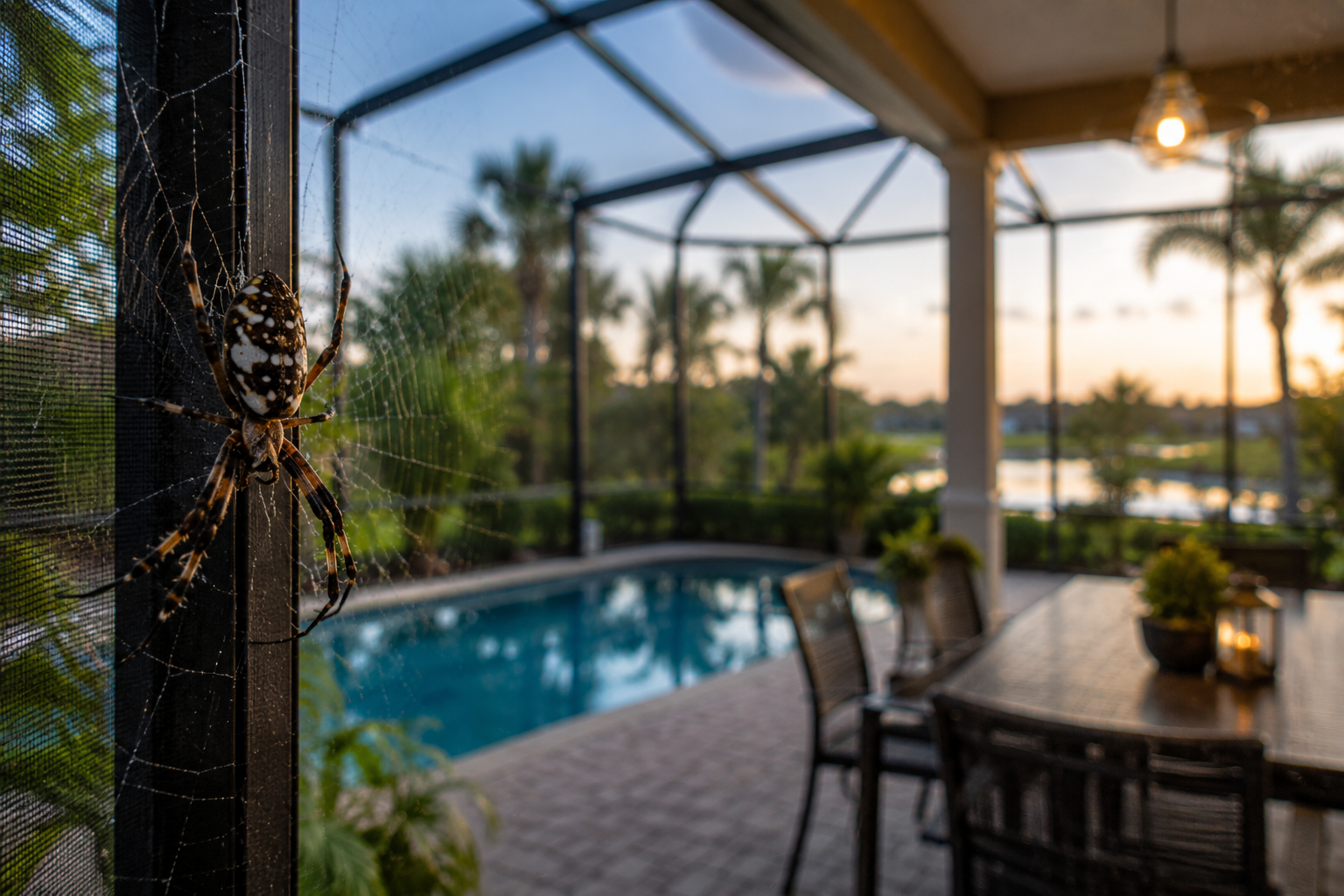
A Cape Coral spider problem becomes a real concern when egg sacs appear in undisturbed corners or webs rebuild within days of cleaning.
It is also a significant issue when activity spreads beyond the lanai into the home or if you find a black widow or brown widow nearby.
These are the signs that a population has established itself rather than passed through.
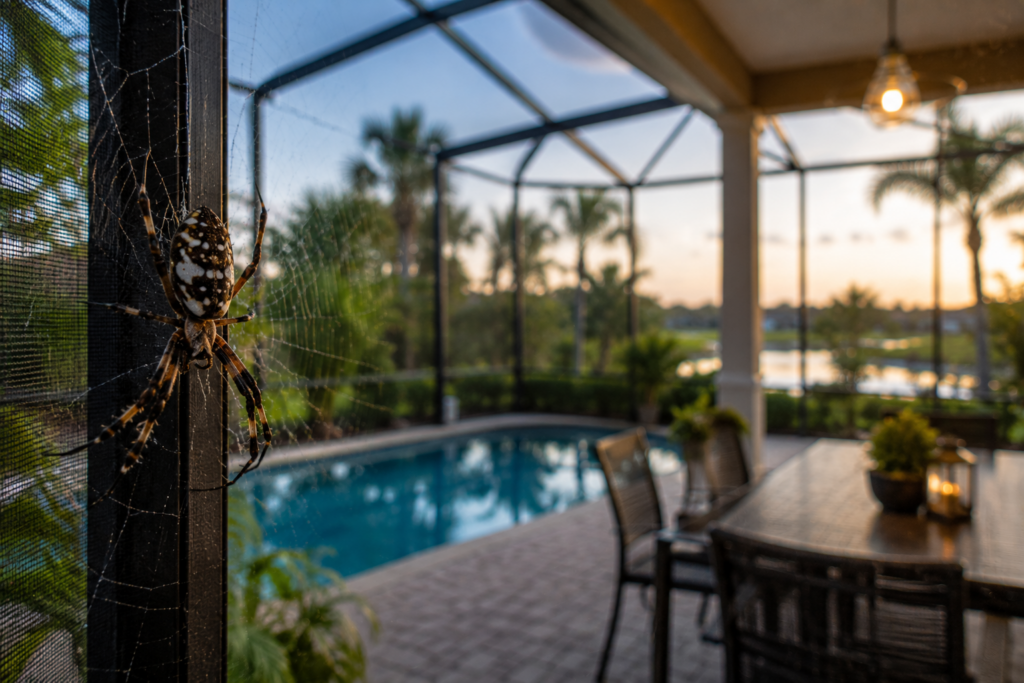
You have probably already swept the lanai, knocked down webs in the pool cage, and maybe pressure-washed the screens and your home. The webs came back. That is normal in Southwest Florida, and it is not always a problem.
But it is worth taking a closer look to assess what species you are dealing with and whether the activity is more than seasonal. If you have already decided you need help, you can request pest control in Cape Coral immediately.
This guide covers how to tell if your lanai spider activity is a real problem, how to identify common species versus concerning ones, why DIY methods often fall short, what a professional inspection should reveal, and how to decide whether to escalate.
How to Tell If Your Lanai Spider Activity Is a Real Problem
Routine lanai spider activity in Cape Coral usually involves a few orb-weaver webs in the corners of the pool cage that you occasionally knock down.
A real problem looks different: web density that outpaces what the local insect supply would normally support; multiple egg sacs in undisturbed areas; rapid rebuilding within days of clearing; or activity that has moved indoors.
Any one of these is reason to look closer.
Web Density: When Webs Outnumber Insects
Spider populations track insect populations. If the number of webs across your lanai or pool cage seems high relative to what you can reasonably expect insect-wise, the spiders may be benefiting from an outside food source, an undisturbed harborage area, or both.
High concentrations of webs at multiple anchor points usually indicate an established population rather than transient activity.
Egg Sacs in Lanai Corners and Under Furniture
Egg sacs are the strongest indicator of an established spider population. Each sac contains dozens to hundreds of spiderlings.
Finding egg sacs in lanai corners, under patio furniture, in the bends of pool cage frames, or in garage corners means the next generation is already in place. Removing visible spiders does nothing to address the eggs.
Black widow egg sacs are smooth, papery, and tan to gray. Brown widow egg sacs are distinctive: tan with spiky surface projections, almost like miniature cocoons covered in points. Orb weaver egg sacs vary by species but are typically silk-wrapped and may be tucked into webs or attached to surfaces.
Spiders Returning Within Days of Cleaning
Some web rebuilding is normal in Cape Coral. Active rebuilding within 24 to 72 hours, in the same locations, indicates that the productive conditions, lighting, anchor points, and insect supply are all still drawing spiders. Cleaning addresses the symptom but not the cause.
Webs Spreading Beyond the Lanai Into the Home
Most lanai spiders stay outside. If you start finding webs in window frames, garage corners, around exterior doors, or inside the home, the population has expanded beyond its usual territory.
This often happens when outdoor populations grow large enough for newly hatched spiderlings to disperse and find their own anchor points.
Identifying Common vs. Concerning Spiders in Cape Coral
Most lanai spiders in Cape Coral are orb weavers, which are harmless web-builders that feed on flying insects.
The two species worth identifying carefully are the southern black widow and the brown widow, both of which are venomous and tend to nest in dark, undisturbed areas around homes. The table below summarizes the key visual and behavioral differences.
Orb Weaver vs. Black Widow vs. Brown Widow
| Feature | Orb Weavers | Black Widow | Brown Widow |
| Body color | Varies; many have spiked or patterned bodies | Shiny black | Tan to dark brown with mottled patterning |
| Key marking | None of medical concern | Bright red hourglass on underside of abdomen | Orange or yellow hourglass on underside of abdomen |
| Web type | Circular, organized, in open areas | Messy, irregular, in dark corners | Messy, irregular, in dark corners |
| Typical hiding spot | Pool cages, lanai supports, screen frames | Garages, sheds, woodpiles, outdoor electrical boxes | Under patio furniture, garage corners, around grills |
| Egg sac appearance | Silk-wrapped, often within webs | Smooth, tan to gray, papery | Tan with spiky surface projections |
| Risk level | Harmless; beneficial pest control | Medically significant bite | Venomous but bites typically milder than black widow |
Orb Weavers, Long-Jawed Orb Weavers, and Other Lanai Regulars
Orb weavers are the spiders most Cape Coral homeowners see in their pool cages. They build organized circular webs across screens, between supports, and at corners.
Spiny-backed orb weavers, long-jawed orb weavers, and golden silk spiders all fall into this category. None are dangerous to humans, and all eat large numbers of mosquitoes and other flying insects.
Black Widow: How to Identify and Where They Hide
Southern black widows are shiny, jet-black spiders with a bright red hourglass marking on the underside of the abdomen. Females are larger than males and produce the medically significant venom.
They build messy, irregular webs in dark, undisturbed areas: garages, sheds, woodpiles, outdoor electrical boxes, and the underside of patio furniture. They are not aggressive and will only bite when pressed against the skin. For full species detail, see the UF/IFAS southern black widow spider profile.
Brown Widow: Increasingly Common Around Cape Coral Homes
Brown widows have become more common in Cape Coral over the past decade. They are tan to dark brown with mottled patterning and an orange or yellow hourglass marking on the underside of the abdomen.
They prefer the same kinds of dark, undisturbed locations as black widows but are often found closer to homes, under patio furniture, in garage corners, and around grills. Their venom is chemically similar to that of the black widow, but bite reactions are typically milder. For complete identification details, see the UF/IFAS brown widow spider profile.
When to Suspect a Venomous Spider Has Settled In
Suspect a widow infestation when you find messy, irregular webs in dark corners that you do not regularly disturb, when you find egg sacs with the spiky brown widow texture or the smooth black widow appearance, or when you spot a spider with the distinctive hourglass marking.
If you or a family member is bitten and you suspect a widow, the CDC spider bite identification and first aid page provides guidance on symptoms and when to seek medical attention. Bites that produce severe pain, muscle cramping, or systemic symptoms require prompt evaluation.
Why DIY Spider Control Often Fails on Cape Coral Lanais
DIY spider control on lanais usually fails for three specific reasons: web removal does not affect eggs, retail sprays and foggers miss spiders hidden in protected locations, and outdoor lighting continues drawing in new spiders every night. Each of these undermines the others, which is why the problem returns even after thorough cleaning.
Sweeping and Pressure Washing Knock Webs Down but Do Not Reach Eggs
A spider can rebuild a web in a single night. Pressure washing or sweeping clears the visible structure but does nothing to egg sacs tucked into corners, frame bends, or under furniture.
Each egg sac can produce dozens to hundreds of new spiderlings. Within a week or two of clearing, the population is back, often larger than before because the next generation has hatched.
Foggers and Sprays Often Miss Hidden Spiders and Egg Sacs
Retail foggers and contact sprays kill spiders they directly reach. They do not penetrate well into the protected areas where widow spiders nest, and they do not reliably kill eggs inside sacs.
A fogger may eliminate visible orb weavers in an open lanai but leave a brown widow population intact under a stack of patio chairs ten feet away. The visible problem improves while the dangerous one persists.
Outdoor Lighting Continues to Attract New Spiders Each Night
Lanai and exterior lights pull mosquitoes and other flying insects from a wide area. As long as the food supply remains high, new spiders will replace those removed. Treatment that does not address the underlying insect attractant is a temporary fix at best.
Schedule My Cape Coral Spider Inspection Now
What a Professional Spider Inspection Should Reveal
A professional inspection should answer three questions: which spider species are present (including any venomous species), where the eggs and primary harborage areas are located, and what conditions on the property are sustaining the population.
Without these answers, treatment is reactive rather than strategic. Paske Pest Control includes spider evaluations as part of its recurring pest control in Cape Coral, which addresses spiders alongside the insect populations they feed on.
Species Identification, Including Any Venomous Species Present
The technician should identify the species on-site. If black widows or brown widows are present, this changes the urgency and the treatment locations.
A general lanai treatment will not be enough if there is a widow population in the garage or under the deck that the inspection did not find.
Egg Sac Locations and Web Mapping
Mapping where webs and egg sacs are concentrated reveals the structure of the population. Egg sacs in lanai corners, frame bends, garage shelves, and under patio furniture all need to be addressed. A treatment plan that targets visible spiders but misses egg sac locations will see the population rebuild within weeks.
Conducive Conditions That Sustain Spider Populations
Outdoor lighting type and placement, vegetation contact with the structure, clutter and storage that provide harborage, and moisture conditions that support insect populations all factor into how quickly spiders return. A good inspection identifies these factors so the homeowner can make changes that reduce long-term pressure, not just current activity.
How to Decide Whether You Need Professional Spider Control
You can likely manage it yourself if the activity is limited to a few orb weavers in the pool cage, you do not see egg sacs accumulating, and the webs do not return aggressively after clearing.
You should call a professional if you have found a black widow or brown widow on the property, if egg sacs are appearing in multiple locations, if webs are spreading beyond the lanai into living areas, or if web rebuilding outpaces your ability to keep up.
For Cape Coral homeowners ready to schedule an evaluation, Paske Pest Control provides spider control with inspections that identify species, locate egg sacs, and address conditions that sustain populations.
Because spider activity is closely tied to the insects they eat, treatments that include ongoing insect control produce longer-lasting results than spider-specific treatments alone.
FAQs
How can I tell if a spider in my Cape Coral home is a black widow or a brown widow?
Both species have an hourglass-shaped marking on the underside of the abdomen. Black widows are jet-black with a bright red hourglass. Brown widows are tan to dark brown with mottled patterning and an orange or yellow hourglass. The egg sacs differ as well: black widow sacs are smooth and papery; brown widow sacs have distinctive spiky surface projections. If you find a spider with the hourglass marking, treat it as venomous and avoid handling it.
Are spider egg sacs in my lanai a sign I need professional treatment?
Often, yes. Egg sacs indicate that a population is established and reproducing rather than just passing through. A single egg sac can produce dozens to hundreds of spiderlings. Multiple egg sacs in different locations point to a population large enough that DIY methods will struggle to keep up. If the egg sacs match the appearance of the widow species, professional inspection is recommended because of the medical risk those species pose.
When should I seek medical attention for a spider bite in Cape Coral?
Seek medical attention if you experience severe pain at the bite site, muscle cramping, abdominal rigidity, sweating, nausea, or any symptoms that spread beyond the bite location. These can indicate a black widow bite. Bites from brown widows tend to produce milder reactions but should still be evaluated if symptoms are significant. Bites from harmless lanai species like orb weavers do not produce these systemic symptoms and rarely require medical care.