
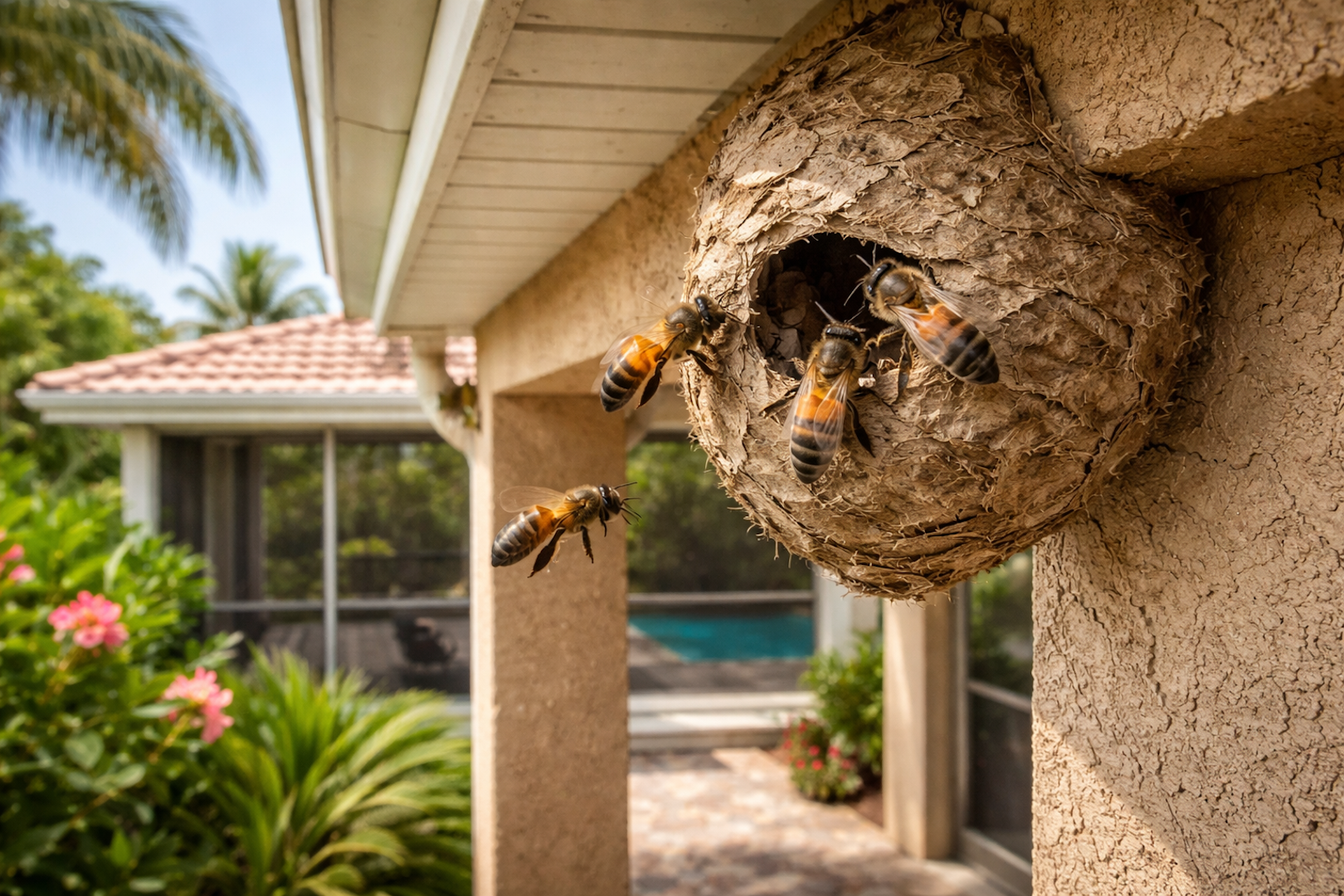
Africanized Honey Bee Removal in Southwest Florida That Eliminates the Colony Safely (AKA, the Killer Bee)
Protect your family, pets, and property from Florida’s most dangerous stinging insect, known as the Killer Bee
Serving Sarasota, Charlotte, Lee, and Collier Counties
★★★★★ 4.8 Google Rating
970+ Reviews
🎖️ Veteran-Owned
👨👩👧👦 Family Operated
✔ 100% Guarantee
WHAT YOU GET
✔ Same-day emergency response available
✔ Positive identification of Africanized vs. European honey bee behavior
✔ Safe colony elimination using protocols designed for highly defensive bee populations
✔ Complete nest and honeycomb removal to prevent secondary pest infestations
✔ Entry point sealing to prevent recolonization
✔ Biologist-supported removal for complex or large-colony situations
Africanized honey bees, also known as killer bees due to their extreme defensive behaviors, in Florida are not a future threat. They are already here.
A large percentage of feral honey bee colonies in Southwest Florida carry Africanized genetics, according to the Florida Department of Agriculture and Consumer Services (FDACS) and the University of Florida. These bees look nearly identical to European honey bees, but their defensive behavior makes them far more dangerous.
Disturbing an Africanized honey bee colony sends hundreds of bees or even thousands into a defensive response across an area up to 40 yards from the nest. They pursue targets for up to a quarter mile.
Spraying a visible cluster with store-bought insecticide does not eliminate the colony. It agitates the bees, scatters survivors deeper into the structure, and increases the risk of a mass stinging event.
Safe removal of Africanized honey bees requires trained professionals with the equipment, protocols, and experience to handle colonies containing tens of thousands of bees.
Why Africanized Honey Bees in Florida Are a Serious Threat to Your Household
Africanized honey bees reached Florida in 2002 and have spread throughout the southern half of the state. From Tampa south, a large percentage of feral bee colonies are Africanized. In Lee, Collier, Charlotte, and Sarasota counties, any wild honey bee colony on your property has a significant chance of carrying Africanized genetics. The only way to confirm the difference is through laboratory testing. You cannot identify them by sight.
How they behave differently:
European honey bees send 5 to 10 defenders when a colony is disturbed. Africanized honey bees send 50 to 100 or more. European bees defend a zone of roughly 20 feet around the nest. Africanized bees defend up to 40 yards and will pursue a perceived threat for a quarter mile or longer. They respond to vibration from lawn mowers, weed trimmers, and power tools. They have been known to attack through standard beekeeping gear.
Where they nest:
Africanized honey bees nest in places European bees typically avoid. Common nesting sites in Southwest Florida include wall voids, soffits, utility boxes, meter enclosures, overturned pots, old tires, hollow trees, sheds, boats, and equipment stored outdoors. They readily nest at ground level and near high-traffic areas. Their willingness to colonize small, unusual cavities close to human activity is what makes them dangerous.
What a stinging event looks like:
A single Africanized honey bee sting is no more venomous than a European honey bee sting. The danger comes from volume. A disturbed colony can deliver hundreds of stings in minutes. Children, elderly family members, pets, and anyone who cannot flee quickly are at highest risk. People with bee sting allergies face life-threatening anaphylaxis. In Florida, there have been documented cases of hospitalizations and deaths from Africanized honey bee attacks, including incidents involving lawn care workers, tree trimmers, and homeowners who unknowingly disturbed a colony.
Safe Africanized Honey Bee Removal That Eliminates the Colony and Prevents Recolonization
Spraying a can of insecticide at a colony entrance kills a handful of bees and sends thousands more into a defensive frenzy. Professional Africanized honey bee removal in Southwest Florida eliminates the colony safely by combining three things.
Assessment:
Your licensed technician assesses the colony location, estimates colony size based on activity levels, identifies all entry and exit points, and evaluates the risk to people, pets, and nearby structures. Africanized honey bee behavior is assessed on site. The defensive perimeter is established to determine safe working distance and whether the area needs to be cleared before treatment begins. You receive a full explanation of the situation and the removal plan before any action is taken.
Colony Elimination and Extraction:
The colony is eliminated using professional-grade application methods and protective equipment rated for Africanized bee encounters. Once the colony is neutralized, all honeycomb, brood, and honey are extracted from the cavity. This step is critical. Leftover honeycomb ferments, leaks through walls, attracts roaches, ants, hive beetles, wax moths, and draws new bee swarms to the same location. Incomplete removal guarantees recurring problems.
Sealing and Prevention:
After extraction, all entry points are sealed with permanent materials to prevent new swarms from recolonizing the same cavity. Africanized honey bees are attracted to sites where previous colonies have lived because residual pheromones and wax signal a viable nesting location. Sealing these entry points eliminates the open invitation. Your technician documents all work with photos and provides recommendations for additional bee-proofing around the property.
Results You Can Expect
✓ Complete colony elimination, including bees, honeycomb, and brood
✓ Entry points sealed with permanent materials to prevent recolonization
✓ Secondary pest attraction from leftover honeycomb eliminated
✓ Free re-service if bee activity returns at the treated site
Safe Africanized Bee Removal in 4 Steps
1
Call Immediately and Stay Away From the Colony
Call Paske Pest Control or request emergency service online. Do not approach, spray, or attempt to block the nest entrance. Keep people and pets at least 100 feet from the colony. Describe the location, estimated size of bee activity, and whether anyone has been stung.
2
On-Site Colony Assessment
Your licensed technician arrives in full protective equipment, assesses colony behavior and location, identifies entry points, and determines the safest removal approach. You receive a clear explanation of the plan, the timeline, and any safety precautions for your household before work begins.
3
Colony Elimination and Honeycomb Extraction
The colony is eliminated using professional-grade methods. All honeycomb, brood, and honey are removed from the cavity. Entry points are sealed with permanent materials. You receive photos and documentation of the full removal.
4
Post-Removal Inspection and Bee-Proofing
Your technician inspects the property for additional nesting sites and potential future entry points. Recommendations for bee-proofing, including sealing utility boxes, soffits, and structural gaps, are provided. If bee activity returns at the treated site, re-service is provided at no additional cost.
Why Paske Africanized Bee Removal Works When Others Fail
✓ Assessment, colony elimination, honeycomb extraction, and sealing handled together
✓ Protective equipment and protocols rated for Africanized honey bee encounters
✓Complete honeycomb and brood removal to prevent secondary pest infestations
✓Entry point sealing with permanent materials to stop recolonization
✓ Same-day emergency response available
✓ Biologist on staff for large colonies, structural nesting, and complex removal situations
✓ 30+ years of pest control experience in Southwest Florida
✓ 100% satisfaction guarantee
Africanized Honey Bee Removal Results Across Southwest Florida
★★★★★ 4.8 Average Rating
970+ Google Reviews
Veteran-Owned & Family Operated
★★★★★
Technician was super polite and courteous. As well he was informative with great purpose in his work. I am impressed and HIGHLY recommend this company.
Dave M.
★★★★★
We had rats in our attic for months. Paske came out same day, identified every entry point, and had the problem solved in under three weeks. Their monitoring gives us peace of mind.
Maria L.
★★★★★
Professional from start to finish. They documented everything with photos and explained exactly what they were doing. The exclusion work is solid and I haven’t had any issues since.
James T.
Africanized Honey Bee Removal Pricing
Complete Africanized Bee Removal Package
Starting at $299 for accessible colony removal
✓ Includes on-site colony assessment, full colony elimination, honeycomb and brood extraction, entry point sealing, documentation, and re-service guarantee.
✓ Custom pricing available for colonies inside wall voids, soffits, and structural cavities requiring access work, as well as commercial properties and multi-colony situations.
Custom pricing available for large properties, commercial locations, or severe infestations.
Africanized Honey Bees in Florida FAQs
How do I know if the bees on my property are Africanized?
You cannot tell by looking at them. Africanized honey bees are only about 10% smaller than European honey bees, a difference invisible to the naked eye. The only confirmed identification method is laboratory testing through the Florida Department of Agriculture and Consumer Services (FDACS). However, behavioral signs indicate a higher likelihood: bees that react aggressively when you are 50 feet or more from the nest, bees that fly directly into the entry hole rather than landing at the threshold, and bees nesting in unusual locations near ground level. If bees on your property show defensive behavior, treat them as Africanized and call a professional.
Are Africanized honey bees common in Southwest Florida?
Yes. According to the University of Florida and FDACS, a large percentage of feral honey bee colonies from Tampa south carry Africanized genetics. Lee, Collier, Charlotte, and Sarasota counties fall within this range. Any wild or feral honey bee colony on your property in Southwest Florida should be treated as potentially Africanized until a professional assesses the situation.
Can I spray the nest myself?
No. Spraying a visible cluster with consumer insecticide kills a fraction of the colony and triggers a mass defensive response from the remaining bees. Africanized colonies can contain 40,000 to 60,000 individuals inside a wall void or cavity. The bees you see at the entrance are a small percentage of the total population. Additionally, Florida law requires that only certified pest control operators apply pesticides to honey bees. Attempting DIY removal puts you, your family, your neighbors, and your pets at serious risk of a mass stinging event.
Why does the honeycomb need to be removed after the bees are eliminated?
Leftover honeycomb ferments and melts, leaking honey and wax through walls and ceilings. This attracts roaches, ants, hive beetles, wax moths, and rodents. Worse, residual pheromones and wax in the cavity signal to passing bee swarms that the site is a viable nesting location. New swarms will move into the same cavity within weeks or months if the comb is not removed and the entry points are not sealed.
What should I do if someone is being stung by Africanized bees?
Run. Get the person away from the colony as quickly as possible. Move in a straight line and get indoors or into a vehicle. Do not swat at the bees as this releases alarm pheromones that attract more defenders. Do not jump into water because the bees will wait for you to surface. Once safely away, call 911 if the person has received multiple stings, shows signs of allergic reaction (swelling, difficulty breathing, dizziness), or is a child or elderly. Remove stingers by scraping them off with a credit card or fingernail rather than pinching, which can inject more venom.
Can Africanized honey bees be relocated instead of eliminated?
The Florida Department of Agriculture and Consumer Services recommends that all feral honey bee colonies be either eliminated by a certified pest control operator or removed alive by a registered beekeeper who will requeen the colony with a European honey bee queen. Live relocation is possible in some situations, but only by a licensed professional equipped to handle Africanized behavior. If the colony location or behavior makes live removal unsafe, elimination is the recommended course of action. Your technician evaluates this during the on-site assessment and discusses all options with you.
Where do Africanized honey bees commonly nest in Southwest Florida homes?
Common nesting sites include wall voids, soffits, eaves, attic spaces, utility boxes, electrical meter enclosures, irrigation valve boxes, barbecue grills, overturned flower pots, sheds, boats, and any cavity or void close to ground level. Unlike European honey bees, Africanized bees readily nest in small, unusual spaces near high-traffic areas. Any increase in bee activity around your home, especially bees entering and exiting a specific gap or hole, should be investigated by a professional before the colony grows larger.
How quickly can an Africanized colony become dangerous?
A swarm can establish a colony in a wall void or cavity within hours of arrival. Within a few weeks, the colony builds comb, begins producing brood, and becomes increasingly defensive as its population grows. The longer a colony is in place, the larger and more dangerous it becomes. If you notice bees entering and exiting a hole or gap in your structure, do not wait to see if they leave on their own. Contact a professional immediately.
How can I bee-proof my property to prevent Africanized colonies?
Seal all gaps, cracks, and openings larger than 1/8 inch in exterior walls, soffits, eaves, and rooflines. Cover vents and utility penetrations with fine mesh screening. Remove debris, old tires, overturned pots, and unused equipment that create cavities. Keep irrigation valve boxes and utility enclosures tightly closed. Trim vegetation away from the structure to increase visibility. These steps reduce the number of viable nesting sites on your property. Your technician provides a full bee-proofing assessment after colony removal.
Is it legal to kill honey bees in Florida?
Florida law requires that only certified pest control operators (PCOs) apply pesticides to honey bees. Homeowners cannot legally apply pesticides to a honey bee colony. If you have a feral bee colony on your property, the legal options are to hire a certified PCO for elimination or contact a registered beekeeper for live removal. Paske Pest Control holds all required FDACS licensing and follows all state regulations for honey bee management in Southwest Florida.
Take the Next Step
Ready to Stop the Cycle?
Schedule service today. Call before noon for same-day availability across Sarasota, Charlotte, Lee, and Collier Counties.