
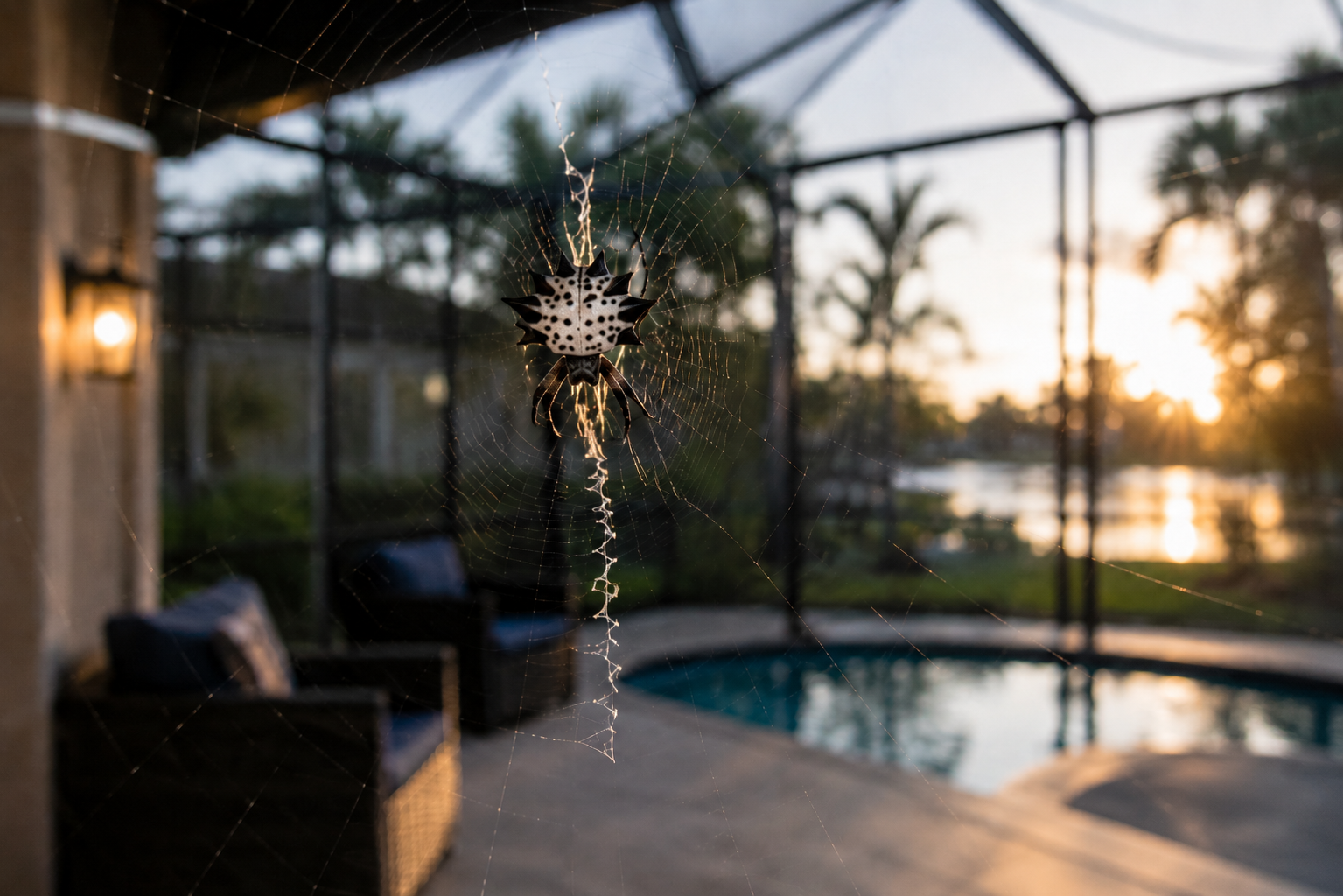
Cape Coral lanais attract so many spiders because lanai lights draw flying insects, and flying insects are exactly what spiders eat.
The screen enclosures provide ideal anchor points for webs, and Southwest Florida’s year-round warmth keeps spider populations active year-round.
The result is a setting that is essentially designed to support spiders, even though it was built for people.
The good news: most spiders you see on a Cape Coral lanai are harmless and beneficial. Florida has roughly 58 spider species, and only five are considered medically significant. The vast majority are pest predators that help keep insect populations down.
For homeowners who want to schedule pest control in Cape Coral, Paske Pest Control offers treatment programs that reduce spider activity around lanais and pool cages without eliminating the beneficial role spiders play.
This guide covers why spiders gather around lanais and pool cages, the most common species in Cape Coral, which ones are dangerous, what conditions on your property attract them, and when professional treatment makes sense.
Why Spiders Love Cape Coral Lanais and Pool Cages
Lanais and pool cages combine three conditions that spiders need: a steady food supply, secure web anchor points, and protection from wind and weather.
Most other locations on a property offer one or two of these.
Lanais offer all three, which is why they consistently have the highest spider activity in a Cape Coral home.
The UF/IFAS guide to spiders in Southwest Florida lanais provides a detailed breakdown of why this happens.
Lanai Lights and Flying Insects Create a Reliable Food Supply
Mosquitoes, midges, moths, and other flying insects are drawn to lanai lights at dusk and through the night. Spiders set up webs where insects gather. A single spider can eat roughly 2,000 insects per year, which means the webs you see on your lanai are actively reducing the insect population around your home.
This is also why lanai spider activity tends to peak during the warmer, wetter months when insect populations are highest.
Screen Enclosures Provide Safe Anchor Points for Webs
Orb weavers and other web-building spiders need stable structures to attach their silk. Lanai screens, frame supports, and pool cage corners offer perfect anchor points.
The screens also block wind, which protects webs from being torn apart. Once a spider establishes a productive location, it tends to stay until disturbed.
Southwest Florida’s Climate Keeps Spider Populations Active Year-Round
Spiders in colder climates die off or go dormant during winter. In Cape Coral, temperatures rarely drop low enough to interrupt their life cycle.
New spiderlings hatch year-round, and adults remain active through every season. This is why lanai webs reappear quickly even after they are cleared away.
Common Spiders Found in Cape Coral Homes and Lanais
The five spiders Cape Coral homeowners encounter most often are the spiny-backed orb weaver, long-jawed orb weaver, golden silk spider, daddy long legs, and jumping or wolf spiders.
None of these species is dangerous to humans. Each plays a role in controlling insect populations around the home.
Spiny-Backed Orb Weaver
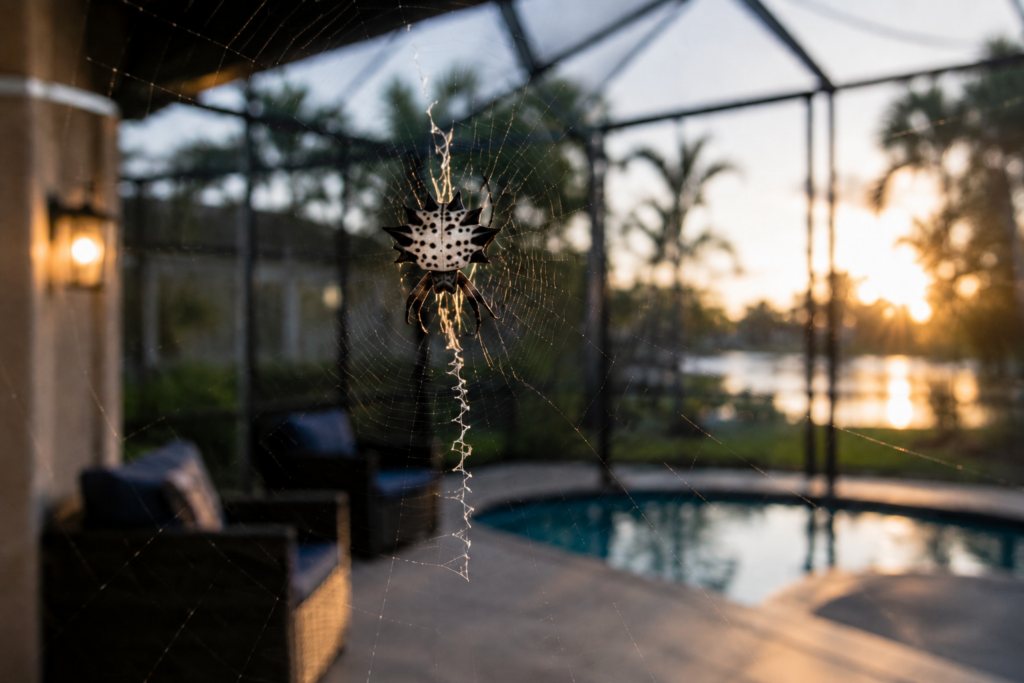
The spiny-backed orb weaver is the spider most Cape Coral homeowners see in their pool cages. It has a small, hard, white or yellow body with six pointed spines and dark legs.
The webs are circular and often built across the corners of the pool cage or between lanai supports. Despite their unusual appearance, these spiders are completely harmless to humans. For detailed identification, see the UF/IFAS spiny-backed orb weaver profile.
Long-Jawed Orb Weaver and Other Orb Weavers
Long-jawed orb weavers are slender spiders with elongated bodies and prominent jaws. They build webs near water, which makes lanais and pool areas natural locations.
Other orb weaver species in Cape Coral include the silver argiope and various smaller garden orb weavers. All are web-builders, all are harmless, and all eat large numbers of flying insects.
Golden Silk Spider (Banana Spider)
Golden silk spiders, often called banana spiders, are large yellow-and-black spiders that build impressive golden-tinted webs.
Females can reach two to three inches across, including legs, which makes them startling to encounter.
Despite their size, they are not aggressive, and their bite is no more harmful than a bee sting. They are most common in wooded or heavily landscaped areas of Cape Coral.
Daddy Long Legs and Cellar Spiders
Daddy longlegs and cellar spiders have small bodies and very long, thin legs. They are often found in garages, storage areas, and the corners of lanais. They are completely harmless.
The popular myth that they are extremely venomous but cannot bite is false. Their venom is not medically significant to humans.
Jumping Spiders and Wolf Spiders
Jumping spiders are small, compact, and often display bright markings or iridescent colors. They do not build webs. Instead, they hunt by stalking and pouncing on prey. Wolf spiders are larger ground-hunters that may enter garages or lanais while searching for insects.
Both are harmless to humans, though wolf spiders are often mistaken for more dangerous species because of their size and speed.
Which Spiders Are Harmless and Which Are Actually Dangerous
Of the roughly 58 spider species in Florida, only the black widow and brown widow are medically significant in Cape Coral. Brown recluses are not established in the state. The remaining species are harmless, and most are beneficial.
Spiders eat mosquitoes, flies, midges, moths, and other insects that bother humans. The average spider consumes around 2,000 insects per year.
A handful of orb weavers in a pool cage can substantially reduce the insect population around your home, which is one reason removing every spider on sight is rarely a good idea.
If a web is in an inconvenient location, knocking it down is a reasonable response. But the spider itself is doing useful work.
For health guidance on spider bites and identification, see the CDC guidance on venomous spider bites.
Black Widow Spiders in Southwest Florida
Black widow females are shiny black with a distinctive red hourglass marking on the underside of the abdomen. They build messy, irregular webs in dark, undisturbed areas: garages, sheds, woodpiles, and outdoor electrical boxes.
They are not aggressive and bite only when pressed against skin. The bite is medically significant and requires prompt evaluation, especially for children, elderly individuals, or those with compromised immune systems.
Brown Widow Spiders Around Cape Coral Homes
Brown widows have become more common in Cape Coral over the past decade. They are tan to dark brown with an orange or yellow hourglass marking.
Their egg sacs have distinctive spiky surfaces that distinguish them from black widow egg sacs. Brown widow venom is similar in chemistry to black widow venom, but bites typically produce milder symptoms. They are commonly found under patio furniture, in garage corners, and around outdoor storage.
Why You Probably Will Not Find a Brown Recluse in Cape Coral
Brown recluses are not native to Florida and are not established in the state. Occasional individuals may be transported in on shipments or moving boxes, but established breeding populations have not been documented in Southwest Florida.
If you suspect you have been bitten by a brown recluse in Cape Coral, the spider responsible is far more likely to be a different species. Most reported recluse bites in Florida turn out to be skin infections or bites from other arthropods.
What Conditions Around Your Home Attract Spiders
Three conditions consistently increase spider activity around Cape Coral homes: outdoor lighting that draws insects, clutter that provides hiding places, and landscaping or moisture conditions near the foundation that support insect populations. Reducing any of these reduces the spider load.
Outdoor Lighting and Insect Activity
Bright outdoor lights pull mosquitoes, moths, and midges from a wide area. The more insects gather near the lanai, the more food is available for spiders.
Switching lanai and exterior lights to yellow bug-rated bulbs or warm-temperature LEDs significantly reduces insect attraction. Motion-activated lighting also helps because the lights are not on continuously.
Clutter, Storage, and Undisturbed Corners
Spiders prefer locations that are stable and undisturbed. Stacked boxes in garages, infrequently moved patio furniture, woodpiles, and corners that are not cleaned regularly all provide harborage.
Black widows and brown widows in particular favor dark, cluttered areas. Keeping storage areas organized and routinely sweeping lanai corners removes the conditions that allow spider populations to settle in.
Landscaping and Moisture Near the Foundation
Dense shrubs, mulch beds, and irrigation systems that keep the soil consistently moist support insect populations along the home’s perimeter.
Those insects feed spiders, which then move inward toward lanais and entry points.
Trimming vegetation back from exterior walls, allowing mulch beds to dry between waterings, and addressing standing water reduces the food supply that keeps spiders close to the structure.
When Cape Coral Homeowners Should Consider Professional Spider Control
Consider professional spider control when webs are rebuilding faster than you can clear them, when you find black widows or brown widows in or around the home, when spider activity is interfering with use of the lanai, or when you want to maintain consistent reduction without constant manual cleaning.
Paske Pest Control provides spider control in Cape Coral, with treatments specifically designed for lanai and pool-cage spider activity.
For homeowners who want ongoing protection rather than one-time treatments, year-round pest control plans cover spiders alongside other common Cape Coral pests.
Because spider activity is driven largely by the insects they eat, controlling the underlying insect population produces longer-lasting results than treating spiders alone.
The goal is not to eliminate every spider on the property. It is to reduce activity in living spaces, address any medically significant species, and keep populations at a level that does not interfere with how you use your lanai.
FAQs
Are the spiders in my Cape Coral pool cage dangerous?
Long-jawed orb weavers and other small orb weavers are also common in pool cages and pose no risk. Black widows and brown widows prefer dark, undisturbed locations like garages or under patio furniture, not open pool cages.
Why do the webs come back so fast even after I clean them?
Lanais and pool cages provide ideal conditions for spiders: a steady supply of insects drawn by lights, secure anchor points on the screens, and shelter from wind. As soon as you clear a web, new spiderlings or relocating adults rebuild in the same productive locations.
In Southwest Florida’s year-round climate, this cycle continues every month of the year. Reducing outdoor lighting and treating the underlying insect population produces longer-lasting results than clearing webs alone.
Do I really have to worry about brown recluse spiders in Cape Coral?
No. Brown recluse spiders are not established in Florida. Individual spiders may occasionally arrive in shipments or moving boxes from other regions, but breeding populations have not been documented in Southwest Florida.
Many reported recluse bites in Florida turn out to be skin infections or bites from other species. If you find a suspicious spider, the more likely candidates in Cape Coral are wolf spiders, jumping spiders, or one of the harmless brown spiders that resemble recluses superficially but lack the violin-shaped marking.