
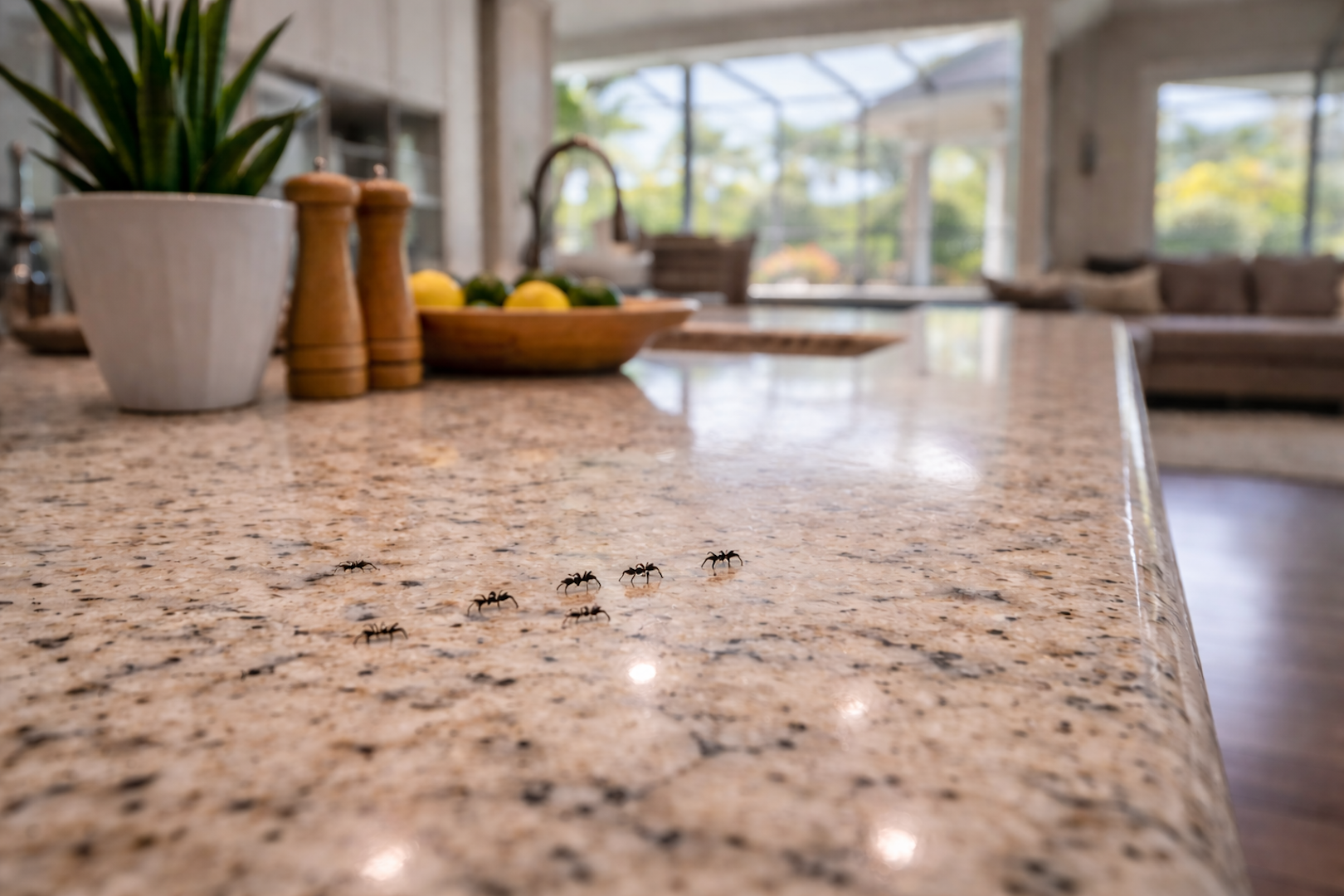
Determining the size of an ant problem in Cape Coral depends on whether you are seeing scouts or a colony rooted in your walls or foundation.
While a few stray ants suggest a nearby colony, recurring trails, activity near electrical outlets, and frass (sawdust-like debris) indicate a deep-rooted infestation that has moved beyond a surface-level nuisance.
In Southwest Florida, the extent of the problem is often tied to the species. Ghost ants and Pharaoh ants are notorious for budding into multiple sub-colonies when sprayed, while Carpenter ants can cause structural damage if left unchecked.
If your DIY traps and sprays haven’t stopped the activity within 48 hours, the colony is likely well established and will require a more strategic approach.
For homeowners already facing persistent swarms, Paske Pest Control provides professional ant control in Cape Coral that targets the colony at its source.
This guide covers how to identify which ants are in your home, the signs of a deeper infestation, why common DIY methods fail for certain species, what a professional inspection should reveal, and how to decide whether you need professional ant control.
How to Identify Which Ants Are in Your Cape Coral Home
The three species Cape Coral homeowners encounter most often are ghost ants, fire ants, and carpenter ants. Each one looks different, nests in different locations, and presents a different level of risk. T
The table below breaks down the key differences to help you determine which species has established itself in your home or yard.
Common Cape Coral Ant Species: Quick Identification
| Feature | Ghost Ants | Fire Ants | Carpenter Ants |
| Size | Very small (1/16 inch) | Small to medium (1/8 to 1/4 inch) | Large (1/4 to 1/2 inch) |
| Color | Dark head, pale translucent body | Red-brown to dark brown | Black or dark brown |
| Common nesting location | Inside walls, behind cabinets, near moisture | Yard mounds, near foundations, landscape beds | Damp or decaying wood; wall voids near moisture |
| Primary risk | Rapid spread through colony budding | Painful stings; aggressive when disturbed | Structural wood damage from nesting galleries |
| Where you will see them | Kitchen counters, bathrooms, sinks | Yard, sidewalks, driveways, near AC units | Window frames, door casings, wood near leaks |
Ghost Ants: Tiny, Translucent, and Found Near Kitchens and Bathrooms
Ghost ants are the most common indoor ant in Cape Coral. They are small enough to be difficult to see and tend to trail along the edges of countertops, sinks, and bathroom fixtures.
Their colonies contain multiple queens and reproduce through budding, meaning a single colony can split into several satellite colonies when disturbed. This is why spraying them often makes the problem worse.
Fire Ants: Red-Brown Mounds in Yards and Near Foundations
Fire ants build dome-shaped mounds in open areas of the yard, along sidewalks, near AC units, and sometimes against the foundation. The mounds can appear overnight after rain.
Fire ants are aggressive when their mound is disturbed and deliver painful stings that can cause allergic reactions in some people. A single yard in Cape Coral can have dozens of mounds connected to a network of underground colonies.
Carpenter Ants: Large, Dark, and Found Near Damp or Decaying Wood
Carpenter ants are the largest common ant species in Cape Coral. They do not eat wood, but they carve out galleries inside it to build their nests. They prefer wood that is already softened by moisture or decay, so they are often found near window frames, bathroom walls, roof lines with leaks, and areas where plumbing has caused water damage.
The key sign of carpenter ant activity is frass, which appears as small piles of wood shavings pushed out of exit holes. This is different from termite frass, which is pellet-shaped and ridged.
Signs of an Ant Infestation that Won’t Go Away
An ant infestation is considered established and beyond the reach of surface treatments when you see recurring trails, activity from multiple species, or ants emerging from within the home’s structure.
While a few stray ants are a nuisance, seeing consistent activity in the same spots indicates a nearby colony is actively foraging and likely nesting inside your walls or foundation.
If you notice any of the following signs, the problem has likely moved past a surface-level issue:
- Recurring Trails: If trails reappear in the same locations within hours of cleaning, the colony has established a permanent pheromone path to a food source.
- Structural Emergence: Ants coming from electrical outlets, baseboards, or wall cavities suggest the nest is located inside the home’s voids where sprays cannot reach.
- Multiple Species: Seeing different types of ants simultaneously, such as ghost ants in the kitchen and fire ants near the door, indicates a complex, multi-colony infestation.
- Carpenter Ant Frass: Small piles of wood shavings (frass) or hollow-sounding wood near window frames or baseboards are direct evidence of structural nesting.
Determining the extent of these signs is the first step in deciding if you need professional ant control in Cape Coral.
Why DIY Treatments Fail for Most Cape Coral Ant Infestations
DIY treatments in Cape Coral often fail because most retail products are repellent contact killers that only eliminate visible foragers. This triggers a survival response called budding in species like ghost ants, where queens scatter to create multiple new satellite colonies throughout the home.
Instead of solving the problem, these sprays often turn one localized nest into a widespread structural infestation.
Effective control requires matching the treatment to the colony’s specific biological needs, which change seasonally. Store-bought baits often fail because they rely on a single attractant that may not align with the colony’s current preference for sugar or protein.
Professional ant control avoids these pitfalls by using non-repellent products that workers carry back to the nest and rotating bait formulations to ensure the colony is neutralized.
When Is Professional Ant Control Recommended in Cape Coral
You can often manage ant issues yourself if you have identified the species and the problem is limited. However, professional intervention is the more reliable path if you encounter complex infestation signs, such as:
- Ants trailing indoors or emerging from walls, outlets, and baseboards.
- Trails returning shortly after you have cleaned or applied DIY sprays.
- Finding carpenter ant frass (wood shavings) near structural beams or window frames.
- Spotting multiple active species at the same time, requiring different treatment strategies.
For homeowners facing persistent swarms, Paske Pest Control offers expert ant control in Cape Coral with precise species identification and targeted plans built for Florida’s year-round pest pressure.
FAQs
Can I have more than one species of ant in my Cape Coral home at the same time?
Yes. It is common in Cape Coral to have ghost ants trailing indoors, fire ant mounds in the yard, and carpenter ants nesting near a moisture source all at the same time.
Each species requires a different treatment method, which is one of the main reasons a single retail product rarely solves the problem in full. A professional inspection identifies every species present, so the treatment plan addresses all of them.
How can I tell if flying insects near my windows are ants or termites?
Check three features: antennae, waist, and wings. Flying ants have bent antennae, a narrow, pinched waist, and a pair of front wings longer than the pair of hind wings.
Termite swarmers have straight antennae, a broad waist with no visible pinch, and two wing pairs that are equal in length. If you find piles of equal-length shed wings near windows or doors, the source is most likely termites.
Why do ghost ants keep spreading after I spray them?
Ghost ant colonies contain multiple queens and reproduce through a process called budding. When the colony detects a repellent spray, one or more queens leave with a group of workers to start a new satellite colony in a different part of the house.
Spraying one trail can turn one colony into several. Professional treatment uses non-repellent products and slow-acting baits that workers carry back to every queen without triggering the budding response.
Why do I see more ants in my kitchen after a heavy rain?
Heavy rain in Southwest Florida often floods underground nests, forcing colonies to seek higher, drier ground. In Cape Coral, this usually means ants move into wall voids or attic spaces and forage in kitchens and bathrooms for food.
This sudden surge is typically a sign that a colony was already established near your foundation and has now moved inside the structure.
Are ant baits from the store enough to stop a Cape Coral infestation?
Most store-bought baits use a single attractant, usually sugar or protein. However, species like ghost ants and carpenter ants frequently switch their dietary needs based on the colony’s growth cycle.
If the bait does not match what the colony needs that week, the workers will ignore it. Professionals use a rotation of baits and non-repellent treatments to ensure the entire colony is eliminated regardless of their current food preference.
Can ants actually damage the structure of my Cape Coral home?
While most ants are just a nuisance, carpenter ants can cause significant structural damage over time. Unlike termites that eat wood, carpenter ants excavate galleries inside damp or decaying wood to create nesting sites.
If you see sawdust-like debris or hear rustling inside your walls, the infestation has likely progressed to a point where it is compromising the wood members of your home.
How do I know if an ant mound in my yard is a threat to my house?
Fire ant mounds near the foundation are a direct threat because these ants often use utility lines, HVAC conduits, or small cracks in the slab to enter the home. If a mound is within five feet of your exterior walls, the risk of an indoor infestation is high.