
Cockroach Control in Southwest Florida That Eliminates the Source (Not Just the Roaches You See)
Stop German and American cockroaches from breeding in your home and contaminating your family’s food
Serving Sarasota, Charlotte, Lee, and Collier Counties
★★★★★ 4.8 Google Rating
990+ Reviews
🎖️ Veteran-Owned
👨👩👧👦 Family Operated
✔ 100% Guarantee
WHAT YOU GET
✔ Same-day service when you call before noon
✔ Species identification to target the right roach with the right treatment
✔ Targeted gel baits and treatments that reach roaches in their harborage, not just open surfaces
✔ Insect growth regulators that stop the breeding cycle
✔ Interior and exterior treatment to eliminate the source and seal off entry points
✔ Family- and pet-safe treatment methods
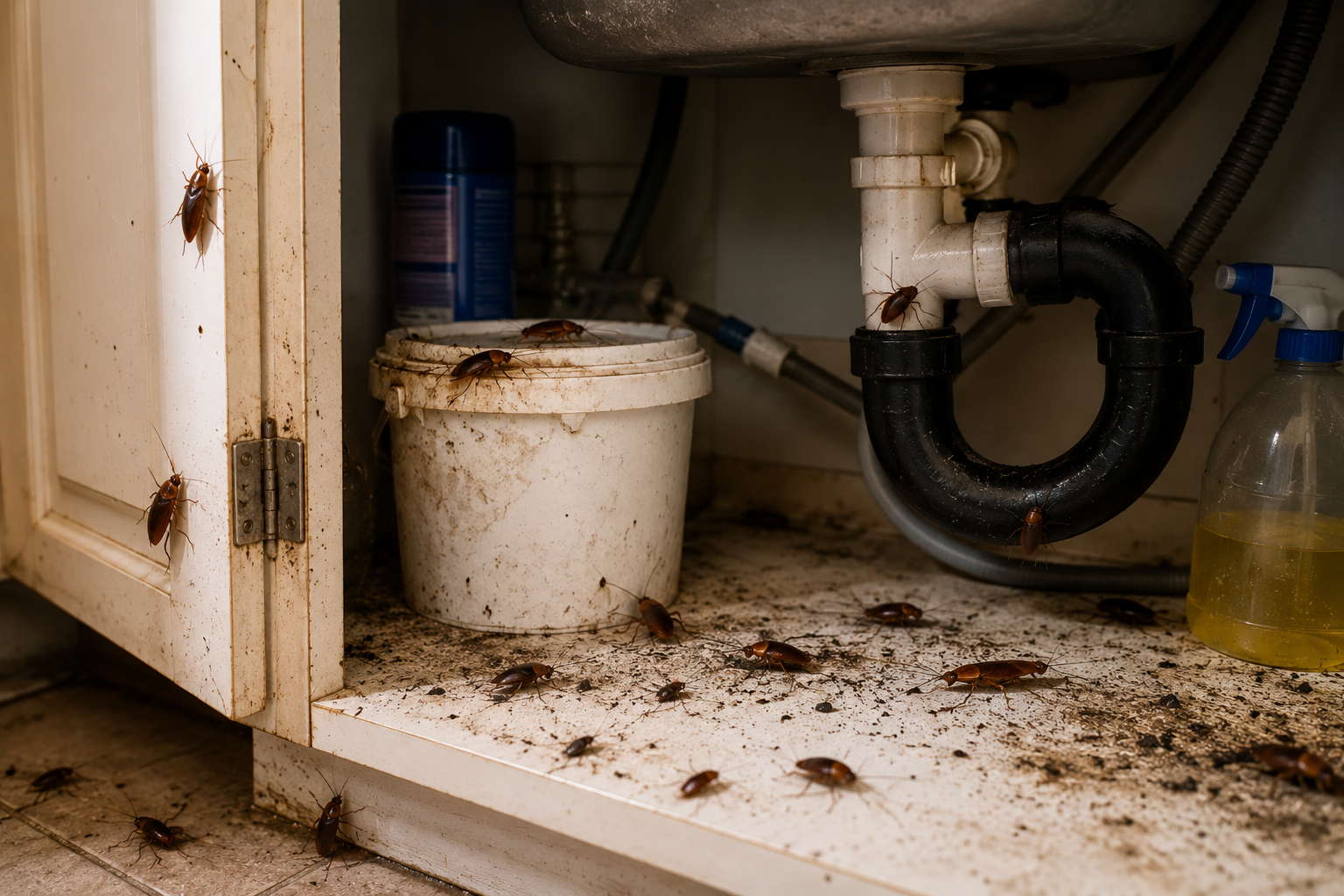
The roaches you see in the open are a fraction of the population.
For every cockroach crossing your kitchen floor in daylight, dozens more are hidden inside walls, behind appliances, and under cabinets.
Daytime sightings mean the harborage areas are already full and roaches are being forced into the open to find food and space.
German cockroaches are the most common indoor roach in Southwest Florida and the hardest to eliminate. A single female and her offspring can produce over 300,000 cockroaches in one year under ideal conditions, according to the University of Florida. They carry bacteria, trigger asthma and allergies, and contaminate every surface they touch.
Cockroaches are a recognized public health pest. The U.S. Environmental Protection Agency and the Centers for Disease Control and Prevention both identify cockroach allergens as a major asthma trigger, especially in children. Store-bought sprays kill the roaches you see but never reach the breeding population behind your walls.
Effective cockroach control requires species identification, targeted treatment that reaches the harborage, and growth regulators that break the reproductive cycle.
Why Cockroaches in Florida Are More Than Just a Nuisance
Florida’s heat and humidity let cockroaches breed year-round. There is no winter die-off. Every species that infests Southwest Florida homes reproduces continuously, and a small problem becomes a full infestation in weeks.
How fast they multiply:
A German cockroach female carries an egg capsule containing 30 to 40 eggs and produces several capsules in her lifetime. Eggs hatch in about a month, and nymphs reach breeding age in as little as 60 days.
This compounding cycle is why German cockroach infestations explode so quickly and why killing visible roaches does nothing to stop the population growing behind your walls.
Where they hide:
German cockroaches cluster in warm, humid areas close to food and water: behind refrigerators and dishwashers, inside cabinet voids, under sinks, behind wall outlets, and in the motor compartments of appliances.
The large outdoor species Floridians call palmetto bugs, including the American cockroach and the Florida woods cockroach, live in sewers, drains, mulch beds, woodpiles, soffits, and tree holes before entering through plumbing and gaps. The species on your property determines where treatment has to go, which is why correct identification matters.
What they cost your health:
Cockroaches spread bacteria, including Salmonella and E. coli, by crawling through sewage and garbage before walking across your counters, dishes, and food.
Their droppings, shed skins, and saliva contain allergens that trigger asthma attacks and allergic reactions, with children at the highest risk. A cockroach infestation is a documented health hazard, not just an unpleasant sight.
The Most Common Cockroaches in Southwest Florida
According to the University of Florida, the roaches found in and around Florida homes include the German, American, smokybrown, Florida woods, Asian, Australian, brown, and brownbanded cockroach. A few drive almost every call in Southwest Florida. Here is what you are most likely dealing with.
German Cockroach (the worst indoor offender)
The German cockroach is the most common indoor roach in Southwest Florida and the hardest to eliminate. It is small, about half an inch long, light brown with two dark stripes running behind the head. Unlike the larger species, it breeds indoors year-round and reproduces faster than any other roach.
It clusters in kitchens and bathrooms close to food, water, and warmth: behind refrigerators and dishwashers, under sinks, and inside cabinet voids. German cockroaches spread quickly between units in apartments and condos and are the species most associated with asthma and allergens.
American Cockroach (the Palmetto Bug)
The American cockroach is the large reddish-brown roach most Floridians call the palmetto bug. Adults grow up to 2 inches long and have a yellowish figure-eight marking behind the head.
It is the second most abundant roach in the state. American cockroaches live outdoors in sewers, drains, mulch beds, and crawl spaces, then enter homes through plumbing, drains, and gaps around the foundation. They can fly or glide short distances and are most active at night.
Florida Woods Cockroach (the Wood Cockroach / true Palmetto Bug)
The Florida woods cockroach, also known as the wood cockroach, is considered by many the true palmetto bug. It is one of the largest roaches in the state at roughly 1.5 inches, dark reddish-brown to black, and slow-moving.
It lives outdoors in leaf litter, mulch, palmetto fronds, woodpiles, and tree holes, and often hitchhikes indoors on firewood. When threatened, it releases a foul-smelling defensive fluid, which is why it is sometimes called the stinking cockroach. It rarely infests indoors but wanders in looking for food and moisture.
Smokybrown Cockroach
The smokybrown cockroach is dark mahogany to black, grows up to 1.5 inches, and is a strong flier highly attracted to light.
It nests outdoors in tree holes, gutters, woodpiles, soffits, and attics. Homeowners most often see it around porch lights or flying inside through open doors and windows at night, especially in spring and summer. It is also lumped under the palmetto bug nickname.
Asian Cockroach
The Asian cockroach looks nearly identical to the German cockroach but is a capable flier strongly drawn to light. It lives outdoors in leaf litter and mulch and flies toward lit windows, doors, and television screens at dusk, peaking in spring and summer after rain.
Because it resembles the German cockroach, correct identification is important so treatment targets the right problem.
Eliminate Cockroaches at the Source and Keep Them From Coming Back
Spraying the roaches you see leaves the breeding population behind your walls untouched. Professional cockroach control in Southwest Florida eliminates infestations at the source by combining three things.
Inspection:
Your licensed technician identifies the cockroach species and traces activity back to harborage areas: behind and under appliances, inside cabinet voids, around plumbing penetrations, and in exterior entry points.
Correct species identification matters because German cockroaches require a different treatment strategy than American or smokybrown cockroaches. You receive a clear explanation of what was found before treatment begins.
Targeted Treatment:
Treatment is applied directly to harborage areas using professional gel baits, crack-and-crevice applications, and insect growth regulators. Roaches feed on the bait, return to the harborage, and transfer the active ingredient to others in the population.
Growth regulators prevent nymphs and eggs from developing into breeding adults. Non-repellent products are used for German cockroaches to avoid scattering the population. Exterior treatment targets entry points and outdoor harborage for American and smokybrown roaches.
Prevention and Monitoring:
Eliminating the current infestation without addressing entry points and conducive conditions invites reinfestation. Scheduled follow-up visits monitor for new activity, maintain the treatment barrier, and catch problems early.
Your technician identifies and helps you correct the moisture, food access, and entry points that attract roaches and other pests, such as ants. Cockroach control is one part of a complete pest control services plan for your home. Every visit is documented.
Results You Can Expect
✓ Visible roach activity eliminated, typically within 2 to 4 weeks
✓ Breeding cycle broken with growth regulators that stop reproduction
✓ Entry points and harborage conditions identified and addressed
✓ Free re-treatment if cockroaches return between scheduled visits
Eliminate Cockroaches in 4 Easy Steps
1
Tell Us What You’re Seeing
Call or request service online. Let us know where you’re seeing roaches, whether you see them in daylight, and how long it has been happening. Daytime sightings indicate a larger hidden population.
2
Same-Day Inspection When Available
Your licensed technician inspects the interior and exterior, identifies the cockroach species, locates harborage areas, and assesses the severity of the infestation. You receive a clear explanation of the findings and the treatment plan before anything begins.
3
Targeted Treatment
Your home receives gel baits, crack-and-crevice treatment, and growth regulators applied directly to harborage areas. Exterior entry points and outdoor harborage are treated to stop new roaches from entering. You receive documentation of the work.
4
Ongoing Monitoring and Prevention
Your technician returns on a scheduled basis to monitor for new activity, maintain the treatment barrier, and adjust as needed. If roaches appear between visits, re-treatment is provided at no additional cost.
Your only job is to enjoy a clean, roach-free home.
Why Paske Cockroach Control Works When Others Fail
✓ Inspection, targeted treatment, and ongoing monitoring handled together
✓ Species-specific strategies for German, American (palmetto bug), smokybrown, Florida woods (wood cockroach), and Asian cockroaches
✓Gel baits and non-repellent treatments that reach the harborage, not just open surfaces
✓Insect growth regulators that break the breeding cycle
✓ Same-day service available
✓ Biologist on staff for severe or recurring infestations
✓ 30+ years of pest control experience
✓ 100% satisfaction guarantee
Cockroach Control Results Across Southwest Florida
★★★★★ 4.8 Average Rating
990+ Google Reviews
Veteran-Owned & Family Operated
★★★★★
Technician was super polite and courteous. As well he was informative with great purpose in his work. I am impressed and HIGHLY recommend this company.
Dave M.
★★★★★
We had rats in our attic for months. Paske came out same day, identified every entry point, and had the problem solved in under three weeks. Their monitoring gives us peace of mind.
Maria L.
★★★★★
Professional from start to finish. They documented everything with photos and explained exactly what they were doing. The exclusion work is solid and I haven’t had any issues since.
James T.
Cockroach Control Pricing
Complete Cockroach Elimination Package
$199 initial service + $49/month monitoring
✓ Includes inspection, species identification, targeted treatment, growth regulator application, documentation, and ongoing monitoring.
✓ Custom pricing available for severe German cockroach infestations, large properties, and commercial locations.
Custom pricing available for large properties, commercial locations, or severe infestations.
SWF Cockroach Control FAQs
Why do I see cockroaches during the day?
Cockroaches are nocturnal and avoid light. Seeing them in daylight usually means the hidden population has grown so large that roaches are being forced out of crowded harborage areas to find food and space. Daytime sightings are a sign of a heavy infestation that needs professional treatment, not a minor problem.
What is the difference between German and American cockroaches?
German cockroaches are small, about half an inch, light brown with two dark stripes behind the head. They breed indoors and are the most common and hardest-to-eliminate roach in Florida homes. American cockroaches are the large reddish-brown roach, up to two inches, that Floridians call the palmetto bug. They typically live outdoors in sewers, drains, and mulch before entering through plumbing and gaps. Each requires a different treatment approach, which is why identification comes first.
What is a palmetto bug? Is it different from a cockroach?
A palmetto bug is a cockroach. Palmetto bug is a Florida nickname for several large outdoor roach species, most often the American cockroach, and also the Florida woods cockroach, smokybrown, and Australian cockroaches. The name comes from their habit of living in palmetto fronds and other outdoor vegetation. The German cockroach is never called a palmetto bug because it is a small indoor breeder, not a large outdoor species.
What is a wood cockroach?
The wood cockroach in Southwest Florida is the Florida woods cockroach, considered by many the true palmetto bug. It is one of the largest roaches in the state at about 1.5 inches, dark reddish-brown to black, and slow-moving. It lives outdoors in leaf litter, mulch, palmetto fronds, and woodpiles, and often hitchhikes indoors on firewood. When threatened it releases a foul-smelling fluid, earning it the nickname stinking cockroach. It rarely infests indoors but wanders in for food and moisture.
Why didn’t store-bought sprays get rid of my roaches?
Over-the-counter sprays kill roaches on contact but never reach the breeding population hidden in wall voids and appliance compartments. They also do not affect egg capsules, which hatch days later. Worse, repellent sprays cause German cockroaches to scatter into new areas, spreading the infestation. Professional treatment uses gel baits and growth regulators that reach the harborage and stop reproduction.
Are cockroaches a health risk?
Yes. Cockroaches carry bacteria like Salmonella and E. coli and contaminate food and surfaces. Their droppings, shed skins, and saliva contain allergens that trigger asthma attacks and allergic reactions, with children at the highest risk. The EPA and CDC both recognize cockroach allergens as a major asthma trigger. Eliminating an infestation protects your family’s health.
Are the treatments safe for children and pets?
Yes. Gel baits are placed in cracks, crevices, and voids where children and pets cannot reach them. All products are EPA-registered and applied according to label directions. Your technician explains any temporary precautions before treatment begins.
How long does it take to get rid of cockroaches?
Most infestations show major improvement within 2 to 4 weeks. German cockroach infestations may require a follow-up visit to break the full breeding cycle, since growth regulators need time to stop new nymphs from maturing. Severe infestations can take longer and benefit from ongoing monitoring.
What if cockroaches come back after treatment?
If roaches return between scheduled visits, re-treatment is provided at no additional cost. That is the Paske guarantee. Ongoing monitoring visits catch new activity early and maintain the treatment barrier so the problem does not return.
What attracts cockroaches to my home?
Cockroaches are drawn to food residue, grease, moisture, and clutter. Common attractants include crumbs and spills, pet food left out, leaky plumbing, standing water, and cardboard or paper storage. Your technician identifies the conditions attracting roaches to your home and helps you correct them as part of the prevention plan.
Do I need ongoing cockroach control?
In Southwest Florida, cockroach pressure never stops. Roaches enter continuously from outdoors, neighboring units, and deliveries. Ongoing monitoring maintains the treatment barrier, catches new activity early, and prevents the conditions that lead to another full infestation, especially for German cockroaches that breed indoors year-round.
Can cockroaches spread between apartment or condo units?
Yes. Cockroaches travel through shared walls, plumbing chases, and electrical conduits between units. In multi-unit buildings, an infestation in one unit often means neighboring units are at risk. Treating the source and sealing entry points is essential to prevent roaches from migrating back in from adjacent spaces.
Take the Next Step
Ready to Stop the Cycle?
Schedule service today. Call before noon for same-day availability across Sarasota, Charlotte, Lee, and Collier Counties.