
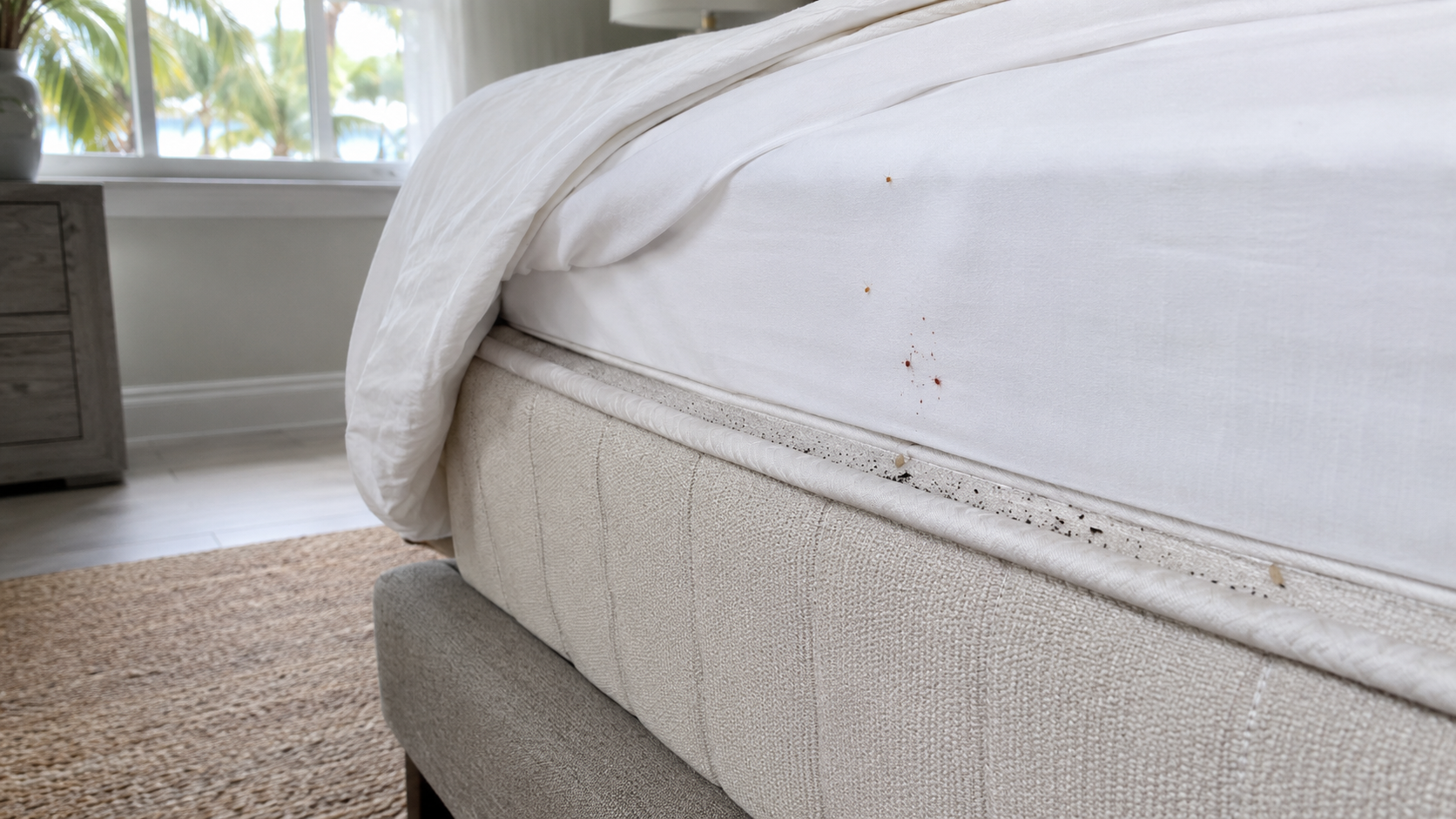
You likely have bed bugs if you are waking with itchy bites in lines or clusters, finding small rust-colored blood spots on your sheets, or spotting live bugs in the seams of your mattress or around the headboard. Any one of these signs is enough to investigate closely.
Bed bugs are small, flat, reddish-brown insects about the size of an apple seed. They hide near where people sleep and feed at night, which is why bites and bedding stains are often the first clues.
This guide covers how to confirm bed bugs, tell their bites from other insects, assess how serious the problem is, and decide whether to call a professional. For help now, Paske Pest Control offers Cape Coral Pest Control and professional Cape Coral bed bug treatment.
Early Signs of Bed Bugs in Your Cape Coral Home
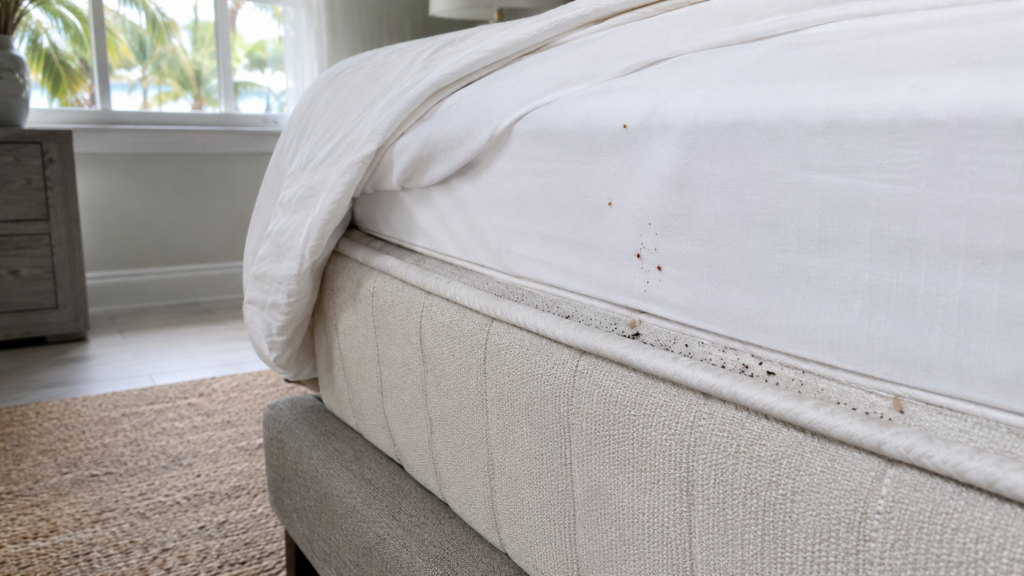
The four most reliable signs of bed bugs are bites in lines or clusters, rust-colored blood spots on bedding, dark fecal specks near sleeping areas, and live bugs or shed skins in mattress seams. Each adds to the picture of the infestation’s activity.
Bites in Lines or Clusters
Bed bug bites often appear in a row or small cluster, usually on skin exposed during sleep, like arms, shoulders, neck, and legs.
Bites alone are not proof, since people react differently, and some show no reaction at all. But bites combined with other signs are a strong indicator.
Rust-Colored Blood Spots on Sheets
Small rust or reddish-brown spots on sheets and pillowcases come from bugs being crushed after feeding or from droplets of digested blood.
These stains are one of the most common early signs people notice, often before seeing a live bug.
Dark Fecal Specks Near Sleeping Areas
Bed bugs leave tiny dark specks, like fine marker dots, along mattress seams, box spring edges, and headboard cracks.
Clusters of these specks indicate a harborage point where bugs hide and digest between feedings.
Live Bugs, Shed Skins, and Egg Casings
Live bed bugs are flat and apple-seed-sized, turning rounder and redder after feeding. They leave behind pale shed skins and tiny white egg casings as the population grows.
Finding any of these in mattress seams or furniture joints confirms an active infestation.
How to Confirm Bed Bugs vs. Other Insects
Bed bugs are most often confused with fleas, mosquitoes, and small cockroach nymphs. The differences come down to where they hide, when they feed, and what their bites look like. The table below helps confirm what you are dealing with. For identification details, see the EPA guide to identifying bed bugs.
Bed Bugs vs. Fleas vs. Mosquito Bites
| Feature | Bed Bugs | Fleas / Mosquitoes |
|---|---|---|
| Bite pattern | Lines or clusters on exposed skin |
Fleas: ankles/lower legs Mosquitoes: random, single |
| When they bite | At night while you sleep | Any time; mosquitoes often dusk and outdoors |
| Where they hide | Mattress seams, headboards, furniture cracks |
Fleas: pets and carpet Mosquitoes: outdoors |
| Physical evidence | Blood spots, fecal specks, shed skins on bedding |
Fleas: seen on pets Mosquitoes: leave no bedding traces |
| Appearance | Flat, reddish-brown, apple-seed sized |
Fleas: tiny, dark, jumping Mosquitoes: flying |
Why Bites Alone Are Not Enough to Confirm
People react to bed bug bites very differently. Some develop large welts, others show nothing at all, even sleeping in the same bed.
Because of this, bites are a clue but not proof. Look for physical evidence on the bed and furniture to confirm.
Where to Look for Physical Evidence
Check mattress seams and tags, box spring edges, the headboard, and the cracks of nightstands and bed frames first. These are the most common harborage points.
In heavier infestations, also check baseboards, outlet covers, curtain folds, and the seams of nearby upholstered furniture.
How to Assess the Severity of a Bed Bug Problem
Severity is measured by where you find evidence, how many bugs and signs are present, and whether the activity has spread beyond the bedroom. A few bugs confined to one mattress is very different from evidence in multiple rooms.
A Localized Infestation vs. a Spreading One
Early infestations are usually confined to the bed and immediate area. Evidence concentrated in the mattress and headboard suggests an early-stage problem.
Evidence in multiple rooms, on couches, or in adjacent furniture indicates a larger, spreading infestation.
How Many Signs and Harborage Points Are Present
A single small cluster of fecal specks points to one harborage. Multiple clusters across the mattress, frame, and furniture indicate a larger population.
The more harborage points you find, the more established the infestation, and the less likely DIY will reach all of them.
Why Bed Bugs Spread Quickly Without Treatment
A single female bed bug can lay hundreds of eggs over her lifetime. Populations grow steadily and spread to new harborage as numbers increase.
This is why bed bug problems do not resolve on their own and tend to get worse the longer they go untreated.
Why DIY Bed Bug Control Usually Fails in Cape Coral
DIY bed bug control fails for three predictable reasons: sprays miss the eggs and deep hiding spots, bed bugs resist many over-the-counter products, and foggers scatter bugs to new areas rather than eliminating them. The EPA guidance on bed bug control emphasizes integrated treatment over single products.
Sprays Miss Eggs and Deep Hiding Spots
Retail sprays kill bugs they directly contact but do not reach eggs tucked in seams, cracks, and wall voids.
Surviving eggs hatch within one to two weeks, and the infestation rebuilds even after the visible bugs are gone.
Bed Bugs Resist Many Over-the-Counter Products
Many bed bug populations have developed resistance to common pyrethroid insecticides found in retail products.
Applying these products may kill a few bugs while the resistant majority survives and continues breeding.
Foggers Scatter Bed Bugs to New Areas
Bug bombs and foggers do not penetrate the cracks where bed bugs hide. Instead, the repellent effect can drive bugs into walls and adjacent rooms.
This often spreads the infestation rather than containing it, making professional treatment harder.
What a Professional Bed Bug Inspection Should Reveal
A professional inspection should answer three questions: whether bed bugs are actually present, where they are harboring, and how far the infestation has spread. This determines which treatment method fits.
Confirmation and Harborage Mapping
The technician should confirm bed bugs by finding live bugs, eggs, shed skins, or fecal evidence, not just relying on bites.
Mapping harborage points across the mattress, furniture, and room edges shows the full scope of the problem.
How Far the Infestation Has Spread
The inspection should check adjacent rooms and furniture to determine whether the infestation is localized or spreading.
This affects which rooms need treatment and whether heat, chemical, or a combination is appropriate.
Which Treatment Method Fits the Situation
Based on severity and layout, the provider recommends heat, chemical, or both. A localized early infestation may be handled differently than a spread, established one.
A good inspection produces a clear recommendation with the reasoning behind it.
How to Decide Whether You Need Professional Bed Bug Control
With bed bugs, the practical answer is almost always professional treatment. Unlike some pests where a small problem can be managed with DIY, confirmed bed bugs rarely respond to retail products and spread quickly while you experiment.
You should call a professional once you have confirmed bed bugs through physical evidence, if bites and signs are recurring, or if the problem has spread beyond one room. Early professional treatment keeps the infestation small and cheaper to resolve.
For homeowners ready to schedule an inspection, Paske Pest Control provides Cape Coral bed bug treatment with confirmation, harborage mapping, and heat or chemical treatment options.
If you want broader protection after treatment, recurring pest control plans cover other common Cape Coral pests, though bed bugs themselves are handled as a dedicated service.
FAQ
How can I tell bed bug bites from mosquito or flea bites?
Bed bug bites usually appear in lines or small clusters on skin exposed during sleep, and you feel them in the morning. Flea bites tend to cluster around the ankles and lower legs, and mosquito bites are usually random, single, and itch immediately.
Bites alone are not proof. Look for blood spots, fecal specks, and live bugs on the mattress to confirm bed bugs.
Where do bed bugs hide?
Bed bugs hide close to where people sleep. The most common spots are mattress seams, box spring edges, headboards, and bed frame cracks.
In larger infestations they also hide in nightstands, baseboards, outlet covers, curtain folds, and the seams of nearby upholstered furniture.
Can I see bed bugs with the naked eye?
Yes. Adult bed bugs are about the size of an apple seed, flat, and reddish-brown, so they are visible without magnification.
Eggs and newly hatched nymphs are much smaller and harder to spot, which is one reason infestations are often confirmed by fecal specks and blood spots first.
Does seeing one bed bug mean I have an infestation?
Often, yes. Unlike a stray ant, a bed bug indoors usually means others are hiding nearby, since they live close to their food source.
Finding one warrants a careful inspection of the mattress, frame, and furniture, and ideally a professional confirmation.
How fast do bed bugs multiply?
Quickly. A single female can lay hundreds of eggs over her lifetime, and eggs hatch in one to two weeks.
This is why infestations grow steadily and why early treatment matters before the population spreads.
How did bed bugs get into my home?
Bed bugs are usually brought in from travel, used furniture, secondhand items, or visitors. They hitchhike in luggage, bags, and on furniture.
They are not a sign of an unclean home. They feed on blood, so cleanliness does not prevent them.
Can bed bugs make me sick?
Bed bugs are not known to transmit disease. The main effects are itchy bites, possible allergic reactions, and the stress and lost sleep of an infestation.
Scratching bites can lead to secondary skin infections, so keep bites clean. If you have a strong allergic reaction, see a doctor.