
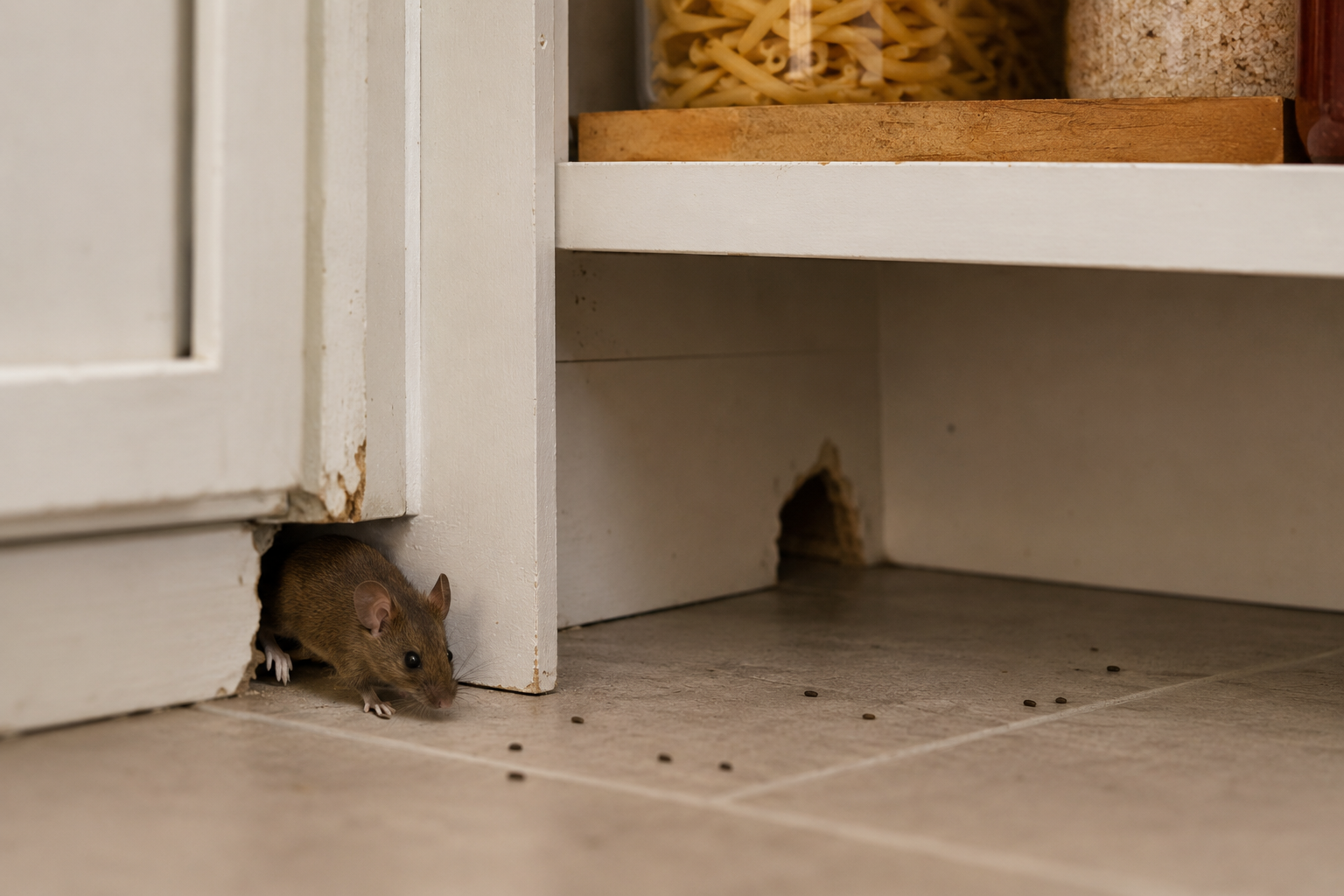
You likely have mice if you are finding small droppings, hearing light scratching after dark, spotting gnaw damage on packaging, or catching a musty odor in an enclosed space. In a home, the first clue is often droppings in a cabinet. In a business, it is more often an employee spotting a mouse dart across a stockroom floor.
House mice are small, gray to light brown rodents that stay close to their nest and hide in concealed, low areas. Because they are secretive, the evidence usually shows up well before the mice themselves do, whether the property is a family kitchen or a commercial break room.
This guide covers how to read the signs, confirm mice versus other pests, judge how serious the problem is, and decide what to do next, for both homes and businesses. For help now, Paske Pest Control offers Cape Coral Pest Control.
Think it might be rats? This guide is about house mice. If the droppings are larger or the noise is up in the attic, see Paske’s Cape Coral rat control resources and the rat guides on the Paske blog.
Early Signs of Mice in Cape Coral Homes and Businesses
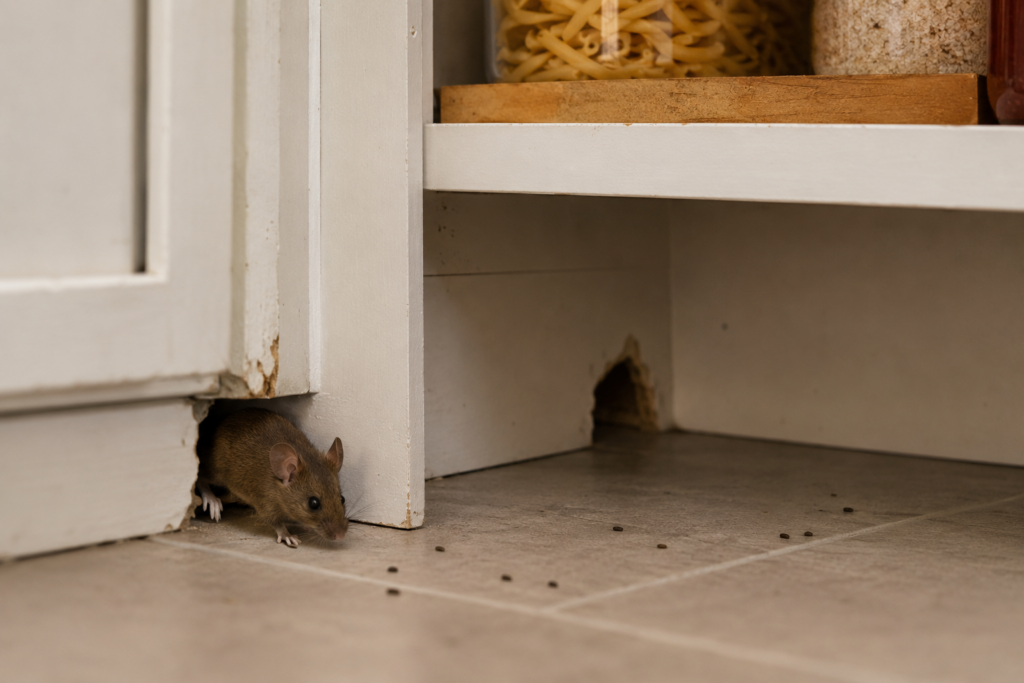
The clearest early signs of mice are small droppings, gnaw damage, grease smudges along walls, and nesting material with a musty smell. In a business, add one more: a daytime sighting by staff or a customer, which is a red flag on any commercial property.
Small, Dark Droppings the Size of a Rice Grain
Mouse droppings are about a quarter inch long, dark, and pointed at the ends, and they scatter wherever mice travel.
At home, look in cabinets, drawers, and pantry corners. In a business, check along stockroom walls, under shelving, and near interior trash and dumpster areas.
Gnaw Damage and Grease Marks Along Walls
Mice open packaging with small, clean gnaw holes and leave dark grease smudges from the oils in their fur as they follow the same routes.
Grease marks along baseboards, pipe runs, and the edges of openings signal a travel route that has been in use for weeks, not a one-time visit.
Nesting Material and a Musty Odor
Mice shred paper, cardboard, fabric, and insulation to build nests, and an established infestation gives off a musty, ammonia-like smell in enclosed spaces.
Finding nesting material in a drawer, a storeroom, or a wall void means mice are breeding on site, not just passing through.
Daytime Sightings, Especially in a Business
Mice are nocturnal, so seeing one during the day usually means the population has outgrown its hiding spots.
In a restaurant, shop, or office, a single daytime sighting can also mean a health-inspection risk, which raises the stakes well beyond a home.
How to Confirm Mice and Rule Out Other Pests
To confirm mice, match the droppings, the sounds, and the nesting spots against what rats and other pests leave behind. The table below shows what each mouse sign looks like and what it tells you. For rat-specific signs, the CDC rodent control resources are a useful reference.
Reading Mouse Evidence
| Sign | What It Looks Like | What It Tells You |
| Droppings | Rice-grain size, dark, pointed, scattered | Active feeding nearby; count grows with the population |
| Grease marks | Dark smudges along walls and openings | A travel route in steady use for weeks |
| Gnaw holes | Small, clean holes in packaging and trim | Mice are reaching food and expanding access |
| Nesting material | Shredded paper, fabric, or insulation | Breeding is happening on the property |
| Musty odor | Ammonia-like smell in enclosed areas | A larger, established population |
| Daytime activity | Mice seen during working hours | Population has outgrown its hiding spots |
Mouse Signs vs. Rat Signs
Dropping size is the quickest tell. Mouse droppings are the size of a rice grain and very numerous, while rat droppings are half an inch or larger and fewer.
Sound helps too: mice make light, fast scratching low in walls and cabinets, while rats make heavier noise, often overhead in the attic.
When to Suspect Something Other Than Mice
A single large rodent that runs low and heavy may be a rat, and daytime attic noise can point to squirrels rather than mice.
If the droppings are tiny and clustered but you never find gnaw holes or nesting material, an insect issue may be the real source, and a professional can confirm which.
Where Mice Hide in Homes vs. Commercial Buildings
Mice hide low and close to food and warmth. In a home that means kitchens, pantries, and cluttered storage. In a business it means stockrooms, kitchens, false ceilings, and the spaces behind and beneath equipment.
Common Hiding Spots in Cape Coral Homes
Check behind and under appliances, inside lower cabinets, in wall voids, and in cluttered garages and closets.
These warm, concealed, low-traffic spots near food are where household mouse activity concentrates first.
Where Mice Hide in Restaurants, Shops, and Warehouses
In commercial spaces, mice favor dry storage, false ceilings, pallet stacks, and the motor housings of coolers, ovens, and other equipment.
Loading docks and back-of-house areas with frequent door traffic are common staging points before mice move deeper into the building.
Why Commercial Layouts Give Mice More Cover
Larger footprints, more equipment, and constant deliveries create more harborage and more ways in than a typical home.
Shared walls in strip plazas also let mice move between units, so a neighbor’s problem can quickly become yours.
How to Judge How Serious a Mouse Problem Is
Severity comes down to how widespread the evidence is and how fast it returns after cleanup. For a home, a few droppings in one cabinet is minor. For a business, any confirmed activity is serious because of the health-code and reputation stakes.
A Few Signs vs. a Spreading Population
Evidence in one spot may point to a single mouse or an early problem, while droppings across several rooms or areas indicate an established population.
If the signs come back within days of cleaning, mice are breeding on the property rather than wandering through.
How Quickly the Problem Can Escalate
Mice reproduce fast enough that a handful can become an infestation in a matter of weeks, since young are ready to breed at about six weeks old.
Waiting to see whether it resolves on its own almost always means dealing with a larger problem later.
Why Any Activity Is Serious in a Commercial Setting
For a food business, a single confirmed mouse can trigger a failed inspection, a temporary closure, or a damaging review.
Because the cost of inaction is so high, most businesses treat any mouse evidence as an immediate priority rather than a wait-and-see issue.
Why DIY Traps and Baits Can Mislead You
DIY tools catch a few mice but rarely reveal the true size of a problem, which is why they mislead homeowners and business owners into thinking it is handled. The EPA guidance on identifying and preventing rodent infestations points to inspection and sealing over products alone.
Catching a Few Mice Hides the Rest
Snap traps tend to catch the boldest mice first, leaving the cautious ones and the breeding core in place.
A few empty-looking days after some early catches can create false confidence while the population keeps growing out of sight.
Store Baits Can Leave Dead Mice in Walls
Bait takes days to work, and mice often die inside wall voids, producing an odor that can linger for weeks.
Over a dining room or a stockroom of goods, that odor is not just unpleasant; it becomes a business problem of its own.
Without Finding Entry Points, You Are Guessing
DIY efforts usually skip the quarter-inch gaps mice use, so removed mice are simply replaced by new ones.
Judging the real scope of a problem requires locating those entry points, which is where a professional inspection earns its value.
What a Professional Mouse Inspection Reveals
A professional inspection answers three questions DIY cannot: whether you have mice or rats, where they are nesting, and every point they use to get in.
For businesses, the FDACS pest control program oversees the licensing that qualifies a provider to perform that work in Florida.
Confirmation and Nest Mapping
The technician confirms the species from droppings and gnaw patterns, then locates nests and maps how far activity has spread.
That picture determines where trapping and sealing should focus, rather than scattering effort and hoping.
The Entry Points You Cannot See From the Floor
Many entry points sit around utility penetrations, equipment, and rooflines that are hard to spot without a trained eye.
In commercial buildings, loading docks, utility chases, and roof access points add openings a homeowner would never think to check.
For Businesses: Documentation and Compliance
Commercial accounts often need inspection reports and monitoring records to satisfy health regulations and internal audits.
A provider that works from an integrated pest management plan can help a business stay compliant while the problem is resolved.
Deciding Whether to Handle It Yourself or Call a Professional
For a home, you may manage a single mouse if the signs do not return after you seal obvious gaps. For a business, confirmed mouse activity almost always warrants professional service because of the compliance and reputation risks.
Call a professional at home if you find droppings in multiple rooms, hear mice in the walls, or keep catching them without the signs stopping. For any commercial property, treat confirmed activity as a reason to bring in a licensed provider right away.
For homeowners and business owners ready for an inspection, Paske Pest Control provides Cape Coral rodent control for both residential and commercial properties, and its recurring pest control plans keep mice in check between visits.
FAQs
How can I tell mouse droppings from rat droppings?
Mouse droppings are about the size of a rice grain, pointed, and very numerous. Rat droppings are noticeably larger, half an inch or more, and fewer in number.
If you are finding many small droppings low in cabinets or along stockroom walls, mice are the likely source.
Why do I see mice during the day in my store or restaurant?
Daytime activity usually means the population has grown large enough that mice are competing for food and space, so some are forced out of hiding.
In a commercial setting, that is a signal to act immediately, both to protect inventory and to avoid a failed inspection.
Does one mouse in my home mean an infestation?
Not always, but it is worth a careful look. Mice live in groups near their food source, so one often means others are nearby.
Check for droppings and nesting material, and if you find either, assume more mice are present than you can see.
How quickly do I need to act if I run a food business?
Right away. A single confirmed mouse can put you at risk of a failed health inspection or a temporary closure.
Prompt professional service and documentation protect both your compliance standing and your reputation.
Can mice damage commercial equipment or inventory?
Yes. Mice chew wiring inside coolers, ovens, and other equipment, and they contaminate stored product with droppings and urine.
The cost of damaged goods and repairs often exceeds the cost of professional control, especially in food service and retail.
Is it safe to clean up mouse droppings myself?
Only with precautions. Droppings and nesting material can carry pathogens, so ventilate the area, wear gloves and a mask, and dampen droppings with disinfectant before removal rather than sweeping or vacuuming.
For heavy contamination in a home or business, professional cleanup is the safer choice.
Will a professional mouse inspection disrupt my business hours?
Usually not much. Inspections and treatment are typically scheduled around operating hours, and most work happens in back-of-house and perimeter areas.
Your provider can plan visits to keep customer-facing spaces undisturbed.