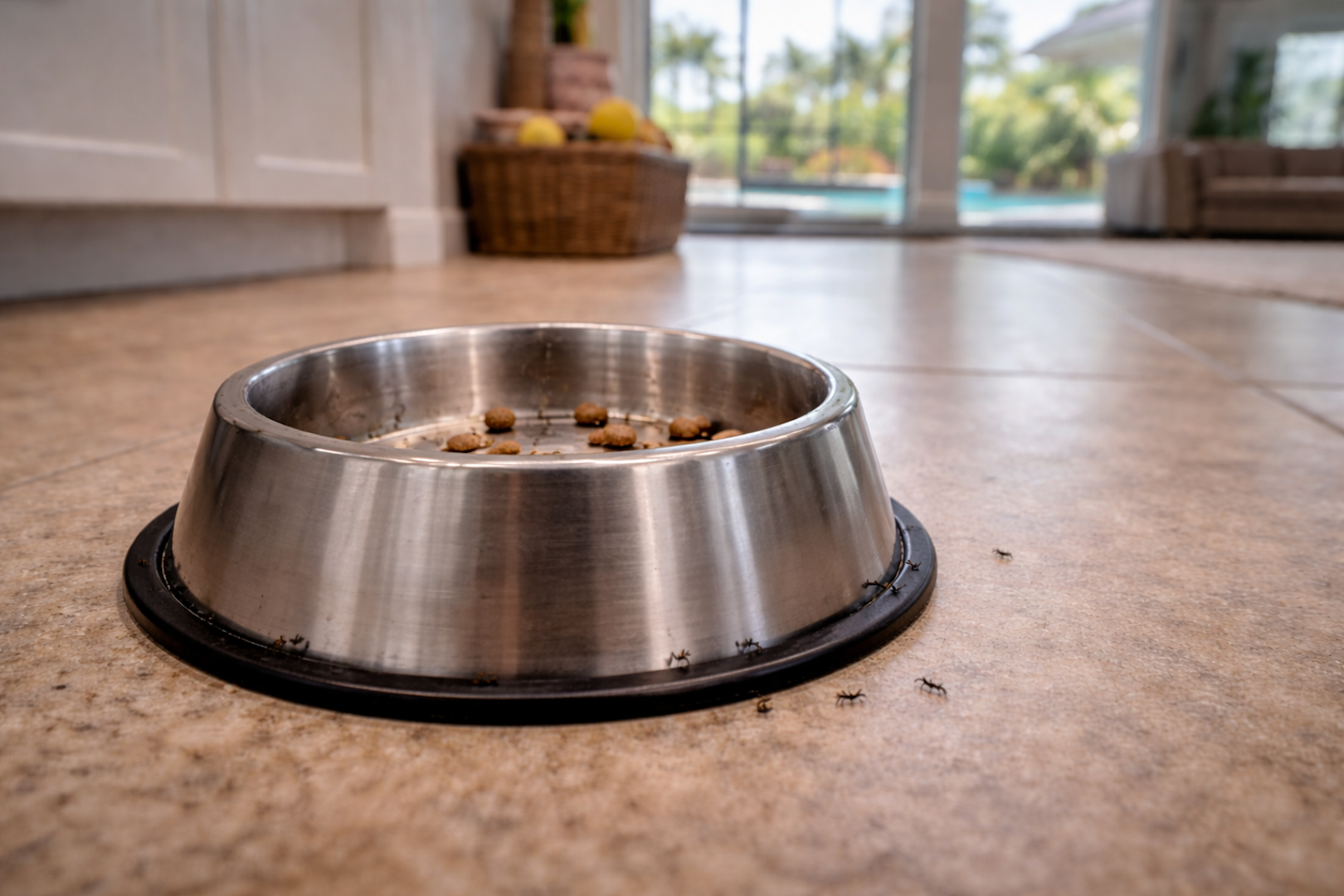
Ants are attracted to Cape Coral homes primarily due to the region’s constant subtropical warmth, high moisture levels from the canal system, and easily accessible food sources like kitchen crumbs or pet food.
Because Florida lacks a killing frost, ant colonies grow year-round, leading to frequent indoor infestations of ghost ants, big head ants, fire ants, and carpenter ants.
Ants present several complications for homeowners once they establish a colony. Ghost ants and odorous house ants build super-colonies inside of wall cavities, overwhelming homeowners with their numbers and contaminating food.
Fire ants deliver painful bites that can harm young children and pets, while carpenter ants nest in wooden structures that can weaken their structural integrity.
Identification is the first step toward resolving an ant infestation, but it also requires eliminating the conditions that attract them.
This guide explains how ant control in Cape Coral works, including how to identify, eliminate, and prevent specific ant species, as well as when to contact a professional.
What Conditions Attract Ants to My Home
Ants are attracted to homes by three main factors: moisture (leaks, high humidity, or standing water), shelter (cracks in foundations or landscaping touching the walls), and food (sugars, proteins, and pet food).
In Cape Coral, the proximity to canals and lush landscaping creates an ideal breeding ground that draws ants toward residential structures.
Moisture Issues, Leaks, and Standing Water
Leaky outdoor faucets, clogged gutters, poor grading that pools water near the foundation, and AC condensation lines that drain against the house all create moisture that sustains ant colonies. Ghost ants and carpenter ants in particular seek out moisture-rich nesting environments.
Fix leaks, direct drainage away from the foundation, and keep the home’s perimeter as dry as possible to prevent ants and other pests.
Mulch, Landscaping, and Wood-to-Soil Contact
Wood mulch retains moisture and provides shelter for ant colonies near the foundation.
Shrubs and tree branches that touch exterior walls create bridges ants use to bypass ground-level treatments. Firewood stacked against the house and landscape timbers in direct soil contact offer nesting sites within foraging distance of entry points.
Keep mulch at least 6 inches from the foundation to prevent ants and termites. Trim vegetation so it does not contact the structure, and store firewood at least 20 feet from the home, elevated off the ground, to prevent carpenter ants.
Pet Food, Open Containers, and Crumbs
Pet food left in bowls overnight, crumbs in cabinet corners, grease residue on stovetops, and open containers of sugar or honey are reliable attractants for ants and cockroaches.
Cleaning alone does not solve an ant problem, but reducing available food sources makes the home a less rewarding target for foraging scouts.
Why Cape Coral Homes Deal With Ants Year-Round
Cape Coral homes face year-round ant problems because the subtropical climate lacks a killing frost, allowing colonies to forage and reproduce without a dormant season.
This constant activity is fueled by high moisture from the city’s canal system and easy access to food sources inside residential structures.
In addition to providing the perfect environment for ants, Cape Coral’s climate ensures they are a persistent issue due to these key factors:
- No Off-Season for Colonies: With average temperatures staying above 60°F and summer highs exceeding 90°F, ant colonies never go dormant. They continue to produce workers and satellite nests through December, meaning infestations never resolve on their own.
- Massive Canal System & Moisture: Cape Coral’s 400 miles of canals, combined with heavy seasonal rains and lawn irrigation, keep the soil consistently damp. This provides the necessary hydration for underground colonies and creates humid nesting sites for species such as ghost and carpenter ants.
- Constant Food Availability: Residential landscaping and indoor environments offer a steady supply of resources. Once scout ants find crumbs, pet food, or moisture around sinks, they lay pheromone trails that guide the entire colony into the home through tiny foundation cracks and utility lines.
- Subtropical Breeding Conditions: The warmth and humidity allow for continuous swarming and reproduction. Without a winter freeze to reduce their populations, ants can reproduce at any time of year.
Which Ant Species Are Most Common in Cape Coral
Florida is home to 257 species of ants, but the five most common found in Cape Coral homes include ghost ants, fire ants, carpenter ants, odorous house ants, and big-headed ants.
Each one has different nesting habits, diet preferences, and risk levels, requiring different treatments.
Ghost Ants
Ghost ants are the most common indoor ant in Cape Coral. They are very small, roughly 1/16 of an inch, with a dark head and a pale, almost translucent body.
They trail along countertops, sinks, and bathroom fixtures, drawn by moisture and sugar. Ghost ant colonies contain multiple queens and spread through budding, which means a single colony can split into several satellite colonies throughout a home.
Fire Ants
Fire ants are the most visible outdoor ant problem in Cape Coral. They build dome-shaped mounds in open areas of the yard, along driveways, near AC units, and sometimes against the foundation. Mounds can appear overnight after rain.
Fire ants are aggressive when disturbed and deliver stings that cause burning, swelling, and, in some case,s allergic reactions.
Carpenter Ants
Carpenter ants are the largest common ant species in Cape Coral, ranging from 1/4 to 1/2 inch. They are dark brown or black and are found near damp or decaying wood.
They do not eat wood, but they excavate galleries inside it to build nests. Over time, this causes structural damage similar to termite damage, though typically progresses more slowly.
Odorous House Ants and Sugar Ants
Odorous house ants are small, dark brown, and produce a distinctive rotten-coconut smell when crushed. They are commonly called sugar ants by Cape Coral homeowners, though that is not their scientific name.
They trail indoors toward sweet foods and moisture. They are a nuisance species that does not cause structural damage or pose health risks beyond food contamination.
Big-Headed Ants and Argentine Ants
Big-headed ants are identifiable by the disproportionately large heads of their soldier caste. They nest in soil and are often found along sidewalks, driveways, and landscape beds.
Argentine ants form supercolonies with multiple queens and can dominate large areas of a yard. Both species are nuisance ants in Cape Coral and do not cause structural damage, but their colony sizes can make them difficult to manage without professional treatment.
Why DIY Ant Sprays Often Make the Problem Worse
Most store-bought ant sprays are repellent-based. They kill ants on contact, but the chemical barrier they leave behind pushes surviving workers to find new routes into the home.
For species like ghost ants and pharaoh ants, which reproduce through colony budding, repellent sprays trigger the colony to split.
The EPA safe pest control guidance recommends identifying the pest species before choosing a treatment method, because the wrong approach can make the problem worse.
Store-bought baits can work for some species when matched correctly, but most retail products use a single attractant type that may not match the target species’ dietary preference.
Professional treatments use non-repellent products that ants cannot detect and slow-acting baits formulated for the specific species present. This allows workers to carry the product back to the colony, reaching the queens and brood that surface sprays never touch.
When Cape Coral Homeowners Should Consider Professional Ant Control
Consider professional ant control when ants keep returning after DIY treatment, when you are seeing ants come from inside walls or outlets, when fire ant mounds rebuild after drenching, or when you find carpenter ant frass near structural wood.
Each of these signals an established colony that surface products cannot reach.
Paske Pest Control provides professional ant control in Cape Coral with inspections, species-based treatments, and ongoing protection plans that prevent ants entirely.
For homeowners dealing with multiple species or recurring infestations, year-round pest control plans provide scheduled treatments that maintain a protective barrier around the home and address new activity before it becomes a full infestation.
In Cape Coral’s year-round ant environment, ongoing protection is the most reliable way to keep ants out of the home long-term.
FAQs
Why do I keep seeing ants in my Cape Coral kitchen even after cleaning?
Cleaning removes the visible ants and weakens the pheromone trail, but it does not affect the colony. Scouts from the nest rediscover food sources quickly and re-establish the trail. If ants return within hours or days of wiping down surfaces, the colony is nearby and actively foraging.
Reducing food sources helps, but eliminating the colony requires treatment that reaches the nest, not just the workers you can see.
Are the tiny ants in my bathroom ghost ants?
Likely, yes. Ghost ants are very small, about 1/16 of an inch, with dark heads and pale, almost translucent bodies and legs.
They are drawn to moisture and are commonly found near sinks, bathtubs, and shower areas. If you are seeing tiny ants that seem to disappear against light-colored surfaces, ghost ants are the most probable species in a Cape Coral home.
Should I worry about carpenter ants if I see a few large black ants?
A few carpenter ants near an exterior door may just be foragers passing through. But if you are seeing them regularly near window frames, bathrooms, or areas with moisture damage, they may be nesting inside the structure.
Look for frass, which resembles small piles of wood shavings, near baseboards or wood trim. If frass is present, the colony is actively excavating wood and should be professionally evaluated before the damage progresses.
Are the ant treatments used in Cape Coral safe for my pets?
Most professional-grade ant treatments are safe for pets once they have fully dried, which usually takes 30–60 minutes in the Florida sun. Professionals typically use targeted baiting in areas pets cannot reach (like wall voids or behind appliances) and low-toxicity perimeter barriers designed for residential safety.
What is budding, and why does it make ants harder to kill?
Budding is a survival mechanism where a single colony splits into multiple new nests after sensing a threat, such as a repellent store-bought spray.
In Cape Coral, ghost ants and pharaoh ants are notorious for budding; spraying them often results in one kitchen infestation turning into several colonies spread throughout the house.
How long does it take to get rid of a full ant infestation?
While you may see a reduction in “scout” ants within 48 hours of treatment, full colony elimination typically takes one to four weeks.
This timeline is necessary because slow-acting baits must be shared by workers with the queens and larvae deep inside the nest to ensure the colony cannot reproduce.